
The burden of unpaid childcare
Women take on the overwhelming proportion of unpaid domestic and care work globally. This is largely a result of social norms and widespread stereotypes that women are the principal caregivers and household work is their prerogative.1 The result—less time to engage in paid work.
Women’s ability to work—often when the first child enters the family—is clearly tied to social norms and the burden of care.2 In some places, a lack of basic infrastructure and public services compounds the volume of unpaid household labour, further infringing on women’s income opportunities.3 Childcare accounts for a significant proportion of this unpaid labour. Affordable, accessible and quality childcare therefore has an important role to play in freeing time for women to engage in income-generating work—it can be seen as an economic opportunity too. The amount of unpaid labour places a particular burden on women in the global south, where childcare services remain limited and there is a higher concentration of workers in the informal economy—which include a lack of regulated working hours, parental leave benefits or employer-supported childcare.4

Extended networks of care
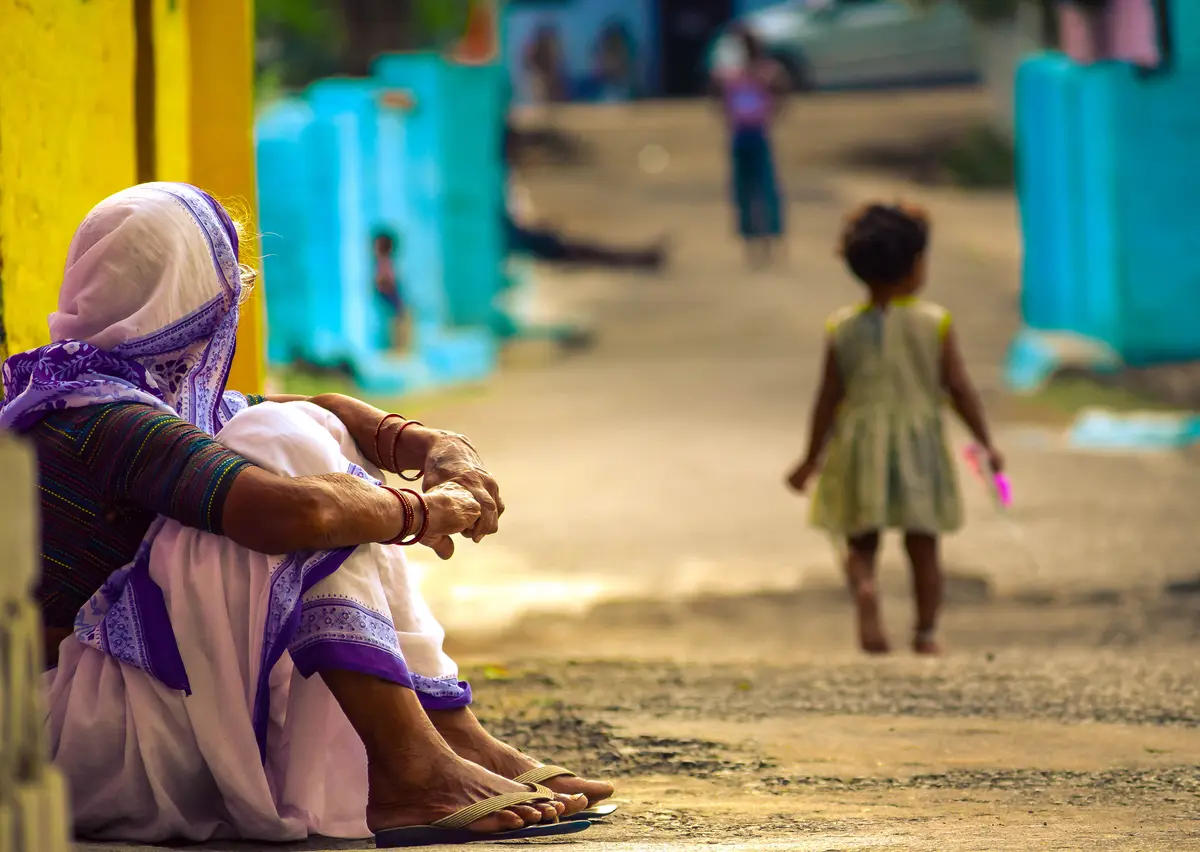
In these situations, informal networks of care—family members, community members and neighbours who replace a formal safety net provided by employers or the state—often take prominence. Informal support becomes a tool by which families navigate disadvantage, such as grandmothers providing childcare in exchange for a mother’s financial and material contributions to a shared household.5 Informal care can also supplement inadequate formal care by aiding in transitions associated with shifting childcare needs or showing up during crisis.6 One potent example from the US shows that close geographical proximity to mothers or mothers-in-law has a substantial positive effect on the labour supply of married women with young children, illustrating how the availability of family members to meet childcare needs is crucial to filling an infrastructure gap in this context.7
The way forward
Steps can be taken to provide more formalised networks of childcare that acknowledge local contexts and needs. A review of survey data from 31 countries in the global south shows that the most common form of childcare among women with the lowest incomes is to care for children while they work,8 but this can result in distraction or stress over children’s wellbeing.9 One local solution is the Makola Market Child Care Centre in Ghana. In Accra, women market traders bring their children to the market’s childcare centre rather than struggling to watch them while they work. This effort is headed by the Ghana Association of Traders, which, after charging a fee to the parents, provides the children with a place to stay during the day, access to a government-approved education curriculum, and a meal at lunch.10 In another example, the Self Employed Women’s Association (SEWA) was founded in 1972 in Gujarat, India. It is a trade union representing 1.8 million women workers in the informal economy across 13 states in India. The trade union runs close to 30 childcare centres in both urban and rural areas, providing full-day services staffed by SEWA members who are chosen from the community.11
Locally specific solutions, such as the two examples highlighted above, illustrate how families can be provided with the care necessary to enable mothers’ economic participation while ensuring children’s safety and wellbeing.
References
- 1Barbieri, Davide, Antonio Garcia Cazorla, Laurène THIL, Blandine Mollard, Julia Ochmann, and Vytautas Peciukonis. "Gender Equality Index 2021: Health." (2021).:
- 2Dey, Judith. "How has labor force participation among young moms and dads changed? A comparison of two cohorts." (2014).:
- 3Moussié, Rachel, and Laura Alfers. "Women informal workers demand child care: Shifting narratives on women’s economic empowerment in Africa." Agenda 32, no. 1 (2018): 119-131.:
- 4ILO and WIEGO. "Extending childcare services to workers in the informal economy: Policy lessons from country experiences." Policy Brief 3 (2020).:
- 5Radey, Melissa, and Lenore M. McWey. "Informal networks of low‐income mothers: Support, burden, and change." Journal of Marriage and Family 81, no. 4 (2019): 953-967.:
- 6Brady, Michelle. "The role of informal childcare in mothers’ experiences of care and employment: a qualitative lifecourse analysis." Lone parenthood in the life course (2018): 237-255.:
- 7Compton, Janice, and Robert A. Pollak. "Family proximity, childcare, and women’s labor force attachment." Journal of Urban Economics 79 (2014): 72-90.:
- 8 ILO and WIEGO. "Extending childcare services to workers in the informal economy: Policy lessons from country experiences." Policy Brief 3 (2020).:
- 9Moussié, Rachel. "Women informal workers mobilizing for child care." WIEGO Research Paper, Cambridge, MA: WIEGO (2017).:
- 10Moussié, Rachel. "Women informal workers mobilizing for child care." WIEGO Research Paper, Cambridge, MA: WIEGO (2017).:
- 11Moussié, Rachel. "Women informal workers mobilizing for child care." WIEGO Research Paper, Cambridge, MA: WIEGO (2017). :


