
The missing middle: finding childcare alternatives for informal workers
The need for better childcare solutions around the world is clear. Currently, 59% of the 593 million children below primary-school-entry age do not have access to childcare.1 In low- and lower-middle income countries, this need is more pronounced: nearly eight out of ten children who need childcare, but do not have access, live in these countries.2
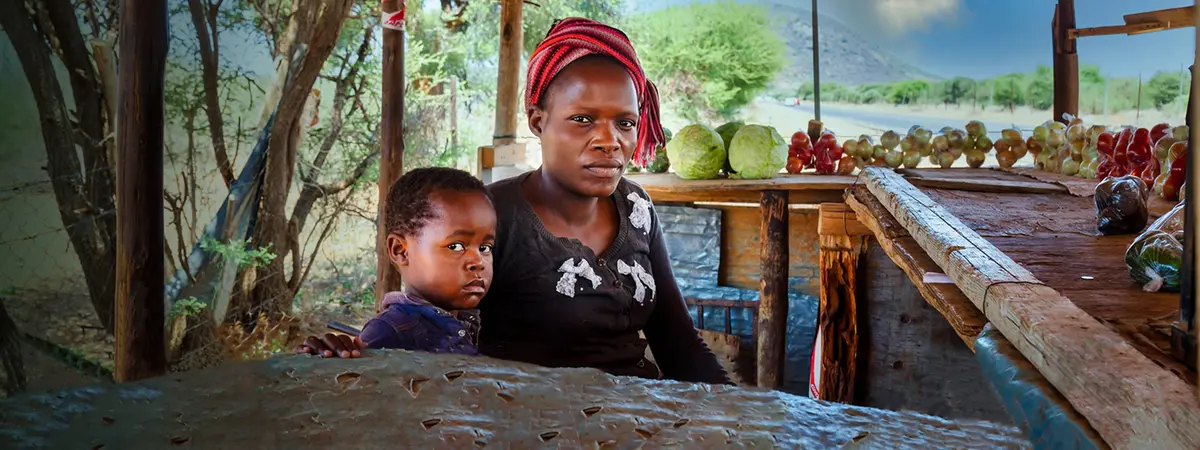
As policymakers explore potential solutions to bridge the childcare gap in the global south, it is important to identify solutions that consider informal workers. Over half of the global workforce is employed in the informal sector—and, rather than declining, its size and scope continues to grow. While informal employment provides a greater source of work for men than women, the share of women in such jobs in low- and lower-middle income countries (92%) exceeds that of men (87%).3
Informal workers often constitute the “missing middle”, as they are excluded from social security regimes in the formal economy such as the provision of paid parental leave and access to affordable and good-quality childcare. Simultaneously, they cannot access social assistance schemes targeted at the extreme poor.

Stuck in the middle
Informal workers are often unable to afford childcare facilities but do not qualify for subsidies or cash transfers targeting the poorest of the poor. Informal workers also have low, unsteady incomes, making it difficult to meet the regular fees of childcare centres. According to the UNESCO Global Education Monitoring Report, across 52 low- and middle-income countries, children aged 3-4 in the richest households were five times as likely to attend organised learning as those from the poorest.4
There is an ongoing debate on whether governments should prioritise childcare coverage for the most vulnerable or increase funding to make childcare universal.5 Providing support—usually in the form of cash transfers—for low-income families to access childcare services is important for combating child poverty. However, focusing exclusively on low-income families can exclude informal workers, leaving the majority of the population without affordable and quality childcare alternatives. Data from 31 low- and middle-income countries show that childcare is mainly provided by unpaid caregivers in the absence of available and affordable childcare. The most frequent unpaid caregivers for children aged under six are employed women, who are therefore doing a "double shift" of paid and unpaid work.6
Finding childcare alternatives for informal workers
Research shows that ensuring universal access to childcare services is more effective than interventions that target only vulnerable groups. Delivering childcare services through the targeting method poses problems like difficulty in correctly identifying target groups, a tendency to stigmatise beneficiaries and possible segregation at further stages of education. A universal child allowance—a monthly, flat cash benefit for every child up to the age of 18—is a highly reliable measure that would support informal workers. The universal nature of this benefit minimises its administrative costs and promotes the efficiency of delivering allowances to families. It also avoids arbitrary benefit cut-offs for working families with children who may see their incomes fluctuate yearly.7
The economic shock that resulted from the covid-19 pandemic is likely to push more waged workers in both the formal and informal economies into informal self-employment, disproportionately affecting women. As the informal economy grows, it is crucial to design policies that address the childcare needs of informal workers and ensure that no family is left behind.
References
- 1Devercelli, Amanda E.; Beaton-Day, Frances (2020) Better Jobs and Brighter Futures: Investing in Childcare to Build Human Capital. World Bank.: https://openknowledge.worldbank.org/handle/10986/35062
- 2Devercelli, Amanda E.; Beaton-Day, Frances (2020) Better Jobs and Brighter Futures: Investing in Childcare to Build Human Capital. World Bank.: https://openknowledge.worldbank.org/handle/10986/35062
- 3UNESCO (2015) Education for All 2000-2015: Achievements and Challenges. Education for All Global Monitoring Report 2015. Paris.:
- 4UNICEF (2017) State of the World’s Children 2017: Children in a Digital World.:
- 5OECD (2021) Net childcare costs in EU countries, 2021: https://www.oecd.org/els/soc/benefits-and-wages/Net%20childcare%20costs%20in%20EU%20countries_2019.pdf
- 6ILO and WIEGO (2019) Quality childcare services for workers in the informal economy: https://www.ilo.org/wcmsp5/groups/public/---dgreports/---gender/documents/genericdocument/wcms_737551.pdf
- 7Bincheng Mao (2022) Can universal child allowance help lift children out of poverty?: https://www.weforum.org/agenda/2022/07/universal-child-allowance-to-end-child-poverty/


