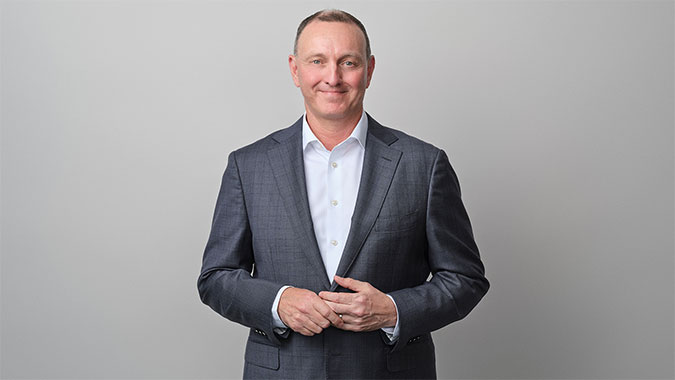
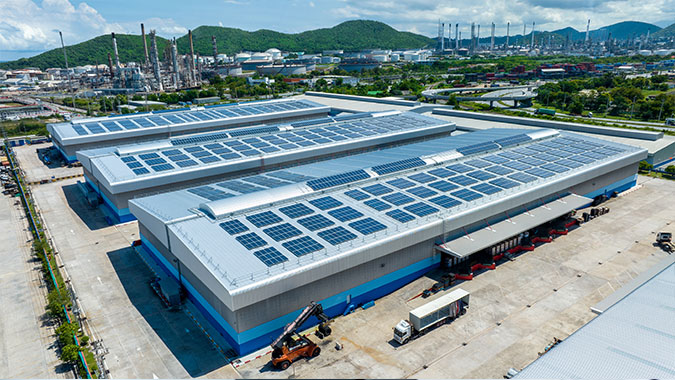
"I started out working at this chemical plant where we had 180 sheep to keep the grass down." The
senior vice president of the Asia Pacific division at commercial property insurer FM thinks back to
that first job, laughing. "I was an environmental engineer and a shepherd—not
exactly traditional.""
What initially sparked his interest to pursue engineering was similarly unconventional. Growing up, Mr
Thompson was an inquisitive kid with a penchant for math and science, and a love of cricket. He
delighted in pouring over an encyclopaedia set his aunt gifted him on his seventh birthday, and that
filled him with a desire to explore the world.
He also just happened to live next-door to a chemical engineer who worked offshore oil rigs in
Tasmania, where he would commute via helicopter. "I thought it was so cool that he took helicopters to
work, and my teenage logic made me think that if you became an engineer, you got to ride in
helicopters," he recalls. Though slightly misguided, it led him to earn a Bachelor of Chemical
Engineering from the University of Melbourne in 1991.
"I thought it was so cool that he took helicopters to work, and my teenage
logic made me think that if you became an engineer, you got to ride in helicopters"
— James
Thompson, Senior vice
president for Asia Pacific, FM
Next up was an offer to work in the local oil and gas industry. For a young man from suburban
Victoria, this was pretty much a dream job—even if the helicopters hadn't arrived, yet. But
curiosity continued to get the better of him, and Thompson was soon hungry for more.
A risk that paid off
A few years in,
a job listing for another engineering role caught his eye; a role that required 120 days of
international travel a year, and he jumped at the opportunity to interview for it. That impulsive move
set in motion a 31-year (and counting) journey at FM. The job description was also spot on; to date,
Thompson has worked in 28 countries around the world.
"I like to call
it industrial tourism," he says. "One day I would be working in a mine in northwest Australia, and the
next, it's a chemical plant in Japan or a food production facility in Hong Kong." The lifelong
friendships he's built in multiple countries have been the most fulfilling part of his career, he
adds. "I don’t travel for business; I travel to go meet friends."
The ascension
continued, as Thompson later accepted an opportunity to move from working on the frontlines as an
engineer to the underwriting side of the business. Although his focus shifted toward more
responsibility for customers, engineering knowledge remained central to his work.
"My
understanding of what could cause factories, power stations, semiconductor plants or mines to shut
down could be applied in a commercial framework," he says. It wasn't long before Thompson was promoted
into leadership positions in Europe and Asia Pacific, where he dealt with both regulators and
commercial partners across the region.
Engineered for leadership
While great
leaders are usually associated with their soft skills and charisma, many bring technical abilities to
the table as well. Consider two titans of Silicon Valley—Steve Jobs and Bill Gates—who both
built their empires off their talent with hardware. In fact, more than 30% of Fortune 500 CEOs have an
engineering degree, including Satya Nadella and Parag Agrawal, chief executive of Microsoft and former
chief executive of Twitter respectively.1
FM regularly
promotes engineers into leadership positions. In recent years, the company has also established
leadership programmes to support and train its engineers as they ascend into management positions, as
well as peer-to-peer mentoring and coaching initiatives.
This reflects
FM's foundational belief in using science and data as the basis of its insurance practice, a
philosophy that dates to its founding by Zachariah Allen in the 1830s. Rather than relying on
actuaries, FM leverages teams of engineers to identify risks and partners with its clients to protect
against losses.
"Anytime a hurricane made landfall, a team of engineers and I would go learn
what went wrong, what caused the roofs to come off or why water flooded one building and not
another. Then we’d take that information back and develop standards to help the industry get
stronger and align with our clients' needs."
— James Thompson, Senior vice
president for Asia Pacific, FM
In 1997, for example, while earning his master’s degree, Thompson was offered a role in FM's staff
engineering group, which saw him move to Boston for four years. "There, I was now developing corporate
standards and engineering standards for how to mitigate against wind and other natural hazards."
"Anytime a
hurricane made landfall, a team of engineers and I would go learn what went wrong, what caused the
roofs to come off or why water flooded one building and not another," he says. "Then we'd take that
information back and develop standards to help the industry get stronger and align with our
clients' needs."
FM's emphasis
on data intelligence sets it apart from competitors, many of which mostly focus on insuring large
portfolios with very homogenous risks, he says. FM's portfolio is smaller and features properties with
unique and large risks, making engineers especially important to the underwriting process.
With a client's
paper mill in the Philippines, it was Thompson's engineering knowledge that enabled him to predict
which section of the roof would come off in the event of a typhoon. Sure enough, two months later,
that exact scenario came to pass. "We were trained to understand how wind would flow over a building,"
he says. "It was a pretty powerful thing for me, reinforcing that this practice does work, and we are
good at predicting things."
That said,
Thompson acknowledges that engineers face their own challenges when moving into management, as he did.
"We engineers tend to want precise answers—in black and white—but leadership and management are not
like that. They are about forming judgements and building consensus. Being right is not enough, and
being alone isn’t going to help you." It is a mantra he has embraced over the years.
A journey of a lifetime, and counting
Looking back at how a boy from humble beginnings has had so
many impactful experiences around the world, Thompson is immensely pleased with not only how his
career has evolved, but more so of those around him.
"You look around the room and see people you've helped
develop—or shepherd—and that's all because of the leaders who have got us to where we are." Industrial
tourism might have been what lured Thompson to FM, but it would be fair to say his industrial family
motivates him to stay.