
Getting more out of benefits: improving upward mobility while strengthening ROI
The sports, media and entertainment industry in the US invests $108 billion in benefits each year, spread among 1.6 million workers and their families. Much of this goes toward insurance, paid time off and retirement, which collectively account for close to 95% of the industry’s benefit investment.1
Beyond their direct monetary value, though, these benefits hold profound social implications. Nearly one in ten workers in our 2023 Benefits 2.0 US worker survey said they are the first in their family to have access to basic benefits such as health insurance or retirement, facilitating their upward mobility. However, our research also revealed critical gaps in the inclusivity and effectiveness of the industry’s benefits. To maximize the return on investment in benefits, employers should consider the four opportunities below.
Make benefits work better for minorities
Racial and ethnic disparities persist within the sports, media and entertainment industry, manifesting as challenges among minorities in accessing and deriving value from their benefits. Black and Hispanic workers, in particular, face hurdles in affording basic healthcare, ensuring a secure retirement and utilizing paid time off (see figure 1).
Percentage who...
Understandably, similar disparities are also reflected in minorities’ less favorable perceptions about their company’s core values, especially as it relates to diversity, equity and inclusion.
These gaps are concerning because they can exacerbate existing inequalities in racial/ethnic representation within the industry.2 3 Companies should take substantive measures to understand the root causes of these challenges and improve the value that benefits provide across all groups. Such steps are crucial to promoting diversity and equity, reducing turnover, and enhancing overall worker well-being.
Attract younger talent with benefits that aid in long-term planning
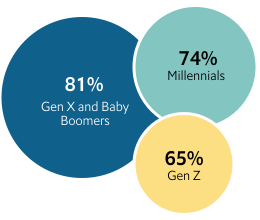
Younger workers have many important life decisions ahead of them, and can therefore hugely benefit from access to support with long-term life planning. However, this is far from the case in reality. Gen Z has the lowest access to financial wellness programs, at just 65%, compared with 81% among older workers (see figure 2).4 This limited access to financial planning and wellness resources could play an important part in younger workers’ concerns about their post-retirement financial security. Only 20% of Gen Z are confident about retiring at the federal age, compared with 57% among other generations.
Access to financial wellness programs
Access to family planning and fertility services
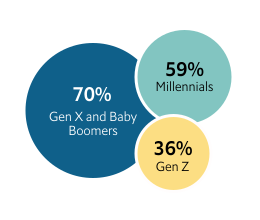
Meanwhile, only 36% of Gen Z workers have access to family planning and fertility benefits, significantly lower than the 66% average seen across other generations. Improving access to these benefits can empower younger workers with control over their futures, careers and reproductive health. Not only does this give them financial security, stability and peace of mind, but it could go a long way toward fostering loyalty among young people.
Rethink education benefits to target skills gaps
Education and training benefits are largely failing to achieve meaningful impact: 60% of workers feel that these resources do not translate to higher earnings or career advancement.
As technological progress and artificial intelligence continue to upend various markets, skills gaps are becoming increasingly pronounced.5 In such a rapidly evolving landscape, companies need to shift their attention to strengthening education and training benefits. Although these benefits are fairly common in the industry, offered to nearly three-quarters of full-time workers, they account for less than 3% of the industry’s total benefit investment.
These findings highlight the need for companies to go beyond mere provision and prioritize relevance, applicability and ongoing support. By regularly assessing the effectiveness of education and training benefits and aligning them with skill requirements in the industry, companies can more effectively empower workers, driving both individual growth and organizational success.
Enhance engagement through inclusive feedback mechanisms
Businesses make substantial investments each year in benefits, yet maximizing returns requires continual reevaluation and engagement with workers. Junior workers in the industry, compared with upper management, find it more challenging to fully utilize their benefits, and they often feel like they have limited representation in decision-making to improve the situation.
Percentage who say their company decides which benefits to offer based on employee feedback
Upper management
Junior workers
Percentage who say their company makes it easy for employees to take full advantage of employer-provided benefits
Upper management
Junior workers
Going the extra mile to include junior workers in these decisions is crucial for ensuring that benefits adequately meet all workers' needs. It can also help avoid situations where businesses pay for benefits that go unused or unappreciated, improving engagement and satisfaction across the workforce.
Conclusion
By investing in benefits that foster inclusive outcomes and greater upward mobility, businesses in the industry also stand to meet strategic organizational objectives, including addressing skills gaps, attracting and retaining top talent, building an engaged and resilient workforce, and reaching diversity, equity and inclusion goals.
Learn more about how employers can optimize benefits to better meet workers’ needs, gain a competitive advantage and drive socioeconomic growth.
Read moreBenefits are a key driver of success in the manufacturing sector. Learn more about workers’ experiences, opportunities for employers and the broader economic impact of benefits.
Read moreBenefits are a key driver of success in the energy and utilities sector. Learn more about industry trends and challenges, opportunities for employers, and how benefits can be optimized to better meet workers’ needs.
Read more

Reasons for nontraditional retirement
Although many workers may feel unprepared to retire or work in fields that make it harder to plan ahead, options like lifetime income can help level the playing field.
Read moreDisclosure statement:
Nuveen and Economist Impact, or any of their affiliates or subsidiaries are not affiliated with or in any way related to each other. The research was independently developed by Economist Impact and is sponsored by Nuveen, LLC. The views and opinions expressed in this publication are those of Economist Impact and do not necessarily reflect the view and policies of Nuveen, LLC.
This material, along with the views and opinions expressed within, are for informational and educational purposes only as of the date of production/writing and may change without notice at any time based on numerous factors, such as market, economic or other conditions, legal and regulatory developments, additional risks and uncertainties and may not come to pass.
All information has been obtained from sources believed to be reliable, but its accuracy is not guaranteed. There is no representation or warranty (express or implied) as to the current accuracy, reliability or completeness of, nor liability for, decisions based on such information, and it should not be relied on as such.
Nuveen, LLC provides investment solutions through its investment specialists.
GAR-3520765CG-E0424W