Advertisement Feature

Breaking barriers to better health
A pioneering fellowship initiative from EMD Serono is working to bridge gaps in care and improve health outcomes for underserved communities
When Luis Manrique-Trujillo was in medical school in Colombia, his professors showed him data that supposedly proved multiple sclerosis (MS) was genetically linked to northern Europe. “If you were from the Americas and you showed symptoms they would scratch their heads and ask if you had any family from Finland, Sweden or Norway,” he recalls.
That narrative shifted dramatically during the 2010s when several studies were published, challenging decades of preconceptions. Analysing data from over 3.5m patient records, one study from Kaiser Permanente showed that black patients were in fact 47% more susceptible to the disease than their white counterparts.1 The long-held belief that MS was a “white person’s disease” had skewed not only diagnoses but also the allocation of resources, depriving countless patients of the opportunity to receive early treatment.
Determined to improve access to care, Dr Manrique-Trujillo applied for funding through EMD Serono's I'M IN Health Equity Fellowship initiative at MedStar Georgetown University Hospital. The initiative provides funding to medical centres to establish fellowships at their institutions dedicated to enhancing neurologic care for MS patients, ultimately advancing health equity and improving patient outcomes.
“Once you realise that our understanding of disease is based on data collected from the 1950s and 1960s, the question to ask is: who had access to specialist care then?” he points out.
With Medicare and Medicaid not established until 19652, large numbers of people from minority ethnic groups lacked health insurance, restricting their access to specialist healthcare and limiting their representation in studies. Over the following decades, the government established healthcare facilities in areas that the incomplete data suggested were hotspots for particular diseases or conditions, unintentionally creating imbalances within the system.

With 22 institutional fellowships funded by EMD Serono across America, I’M IN fellows are working to expand access to care at the local and regional level in neurology, immunology, oncology and fertility.
John Doe, Head of Lorem Ipsum
back to top
Addressing imbalances
Today, those gaps in care are being tackled directly. With 22 institutional fellowships funded by EMD Serono across America, I’M IN fellows are working to expand access to care at the local and regional level in neurology, immunology, oncology and fertility. They bring together clinicians, healthcare providers and affected communities to highlight gaps in care and drive meaningful change. In Buffalo, researchers are examining the underrepresentation of minority patients in MS clinical trials across the region, while in Chicago and Washington, DC, they are identifying where uninsured patients seek care—and how they can be better supported.
A lack of diversity among specialists across medical fields is also a critical obstacle to building inclusive health systems. A 2020 study by the American Society for Reproductive Medicine found that a lack of minority representation among reproductive specialists was leading to “implicit biases and discrimination by some offices”, posing immense burdens to infertile individuals of diverse backgrounds.3
To address this, EMD Serono funded an I'M IN Health Equity Fellowship in 2021 that connected resident doctors in underserved areas (who are themselves more likely to be from minority backgrounds) with reproductive endocrinology and infertility specialists in other areas of the country. By providing these pairings with funding for research into the barriers to fertility treatment, the initiative aims to provide much-needed mentorship to fellows, raise the profiles of doctors from minority backgrounds and improve outcomes for all patients.
USD$
bn
A 2022 Deloitte study found that gaps in US healthcare access cost US$320bn in lost economic productivity each year, a figure that could rise to more than US$1trn by 20405.
For MS patients, early diagnosis is vital to slow disease progression and minimise long-term disability. But rural areas or communities where English is not the first language often face significant delays.
“When I arrived in Virginia, I realised that most people in rural communities don’t have access to a neurologist, let alone a specialist,” says Robert Shin, director of the multiple sclerosis and clinical neuroimmunology division at UVA Health and previously a fellowship director at MedStar. “The stories are so heartbreaking because they have had obvious neurological symptoms, but it'll be ten years before anybody thinks to check.”
In Washington, DC, Dr Manrique-Trujillo began investigating where underserved minority patients seek treatment. He found a volunteer medical clinic run by Catholic Charities, where 90% of patients were immigrants without legal status. Upon becoming the clinic’s first neurologist, Dr Manrique-Trujillo discovered that the vast majority of its patients travelled extraordinary distances for care, and that some could not speak English, making it difficult to diagnose symptoms and prescribe accurate treatment.
To tackle these challenges, Dr Manrique-Trujillo developed a mobile healthcare centre to bring resources directly to these communities, providing information on chronic conditions.
Lori Lebson, EMD Serono’s North America head of medical affairs, has played a key role in the creation of the I’M IN fellowship initiative. “Most of us probably don't recognise some of these barriers because we're not living them every day,” she says. “But we can make it better for physicians and patients.”
All In
Most of us probably don't recognise some of these barriers because we're not living them every day. But we can make it better for physicians and patients.
Lori Lebson, EMD Serono’s North America head of medical affairs
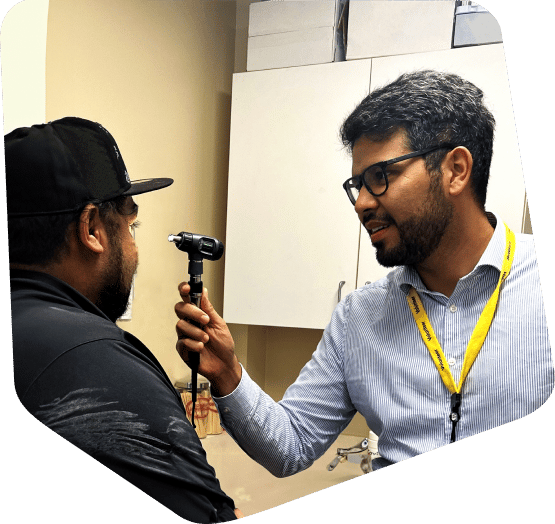
Dr Manrique-Trujillo meets a patient at a volunteer medical clinic in Washington, DC.
PHOTOGRAPH: CATHOLIC CHARITIES/VOLUNTEER MEDICAL CLINIC

Lorem ipsum dolor sit amet, consectetur adipiscing elit, sed do eiusmod tempor incididunt ut labore et dolore magna aliqua. Ut enim ad minim veniam, quis nostrud exercitation ullamco laboris.
John Doe, Head of Lorem Ipsum
One of the key tools to help do this is telemedicine and artificial intelligence (AI), which can connect patients from Hispanic or Latin American backgrounds with Spanish-speaking specialists and provide real-time translations for information on chronic conditions. However, these technologies are not without limitations. The most vulnerable demographics often lack the connectivity or digital literacy to make telemedicine effective, and AI models must be carefully designed to avoid reinforcing existing biases already built into the healthcare data.4
The cost of inaction is staggering. A 2022 Deloitte study found that gaps in US healthcare access cost US$320bn in lost economic productivity each year, a figure that could rise to more than US$1trn by 20405. These findings reinforce the urgent need for change and underscore the work of I’M IN fellows to expand healthcare access and improve patient outcomes.
References
- Kaiser Permanente, Incidence of multiple sclerosis in multiple racial and ethnic groups, May 2013
- Centers for Medicare & Medicaid Services, History, October 2024
- American Society for Reproductive Medicine, ASRM Taskforce of Equity, Diversity, and Inclusion November 2020
- JAMA Network, Bridging the Digital Divide to Avoid Leaving the Most Vulnerable Behind , March 2021
- Deloitte Global, US health care can’t afford health inequities, June 2022
©2025 The Economist Group. All rights reserved. The Economist Group endeavors to provide accurate information; however, neither The Economist Group nor its affiliates can accept any responsibility or liability for reliance by any person on this information. Asset commissioned by EMD Serono. EMD Serono is the Healthcare business of Merck KGaA, Darmstadt, Germany in the U.S. and Canada. US-NONNI-02177 03/25.
Produced by EI Studios for EMD Serono
