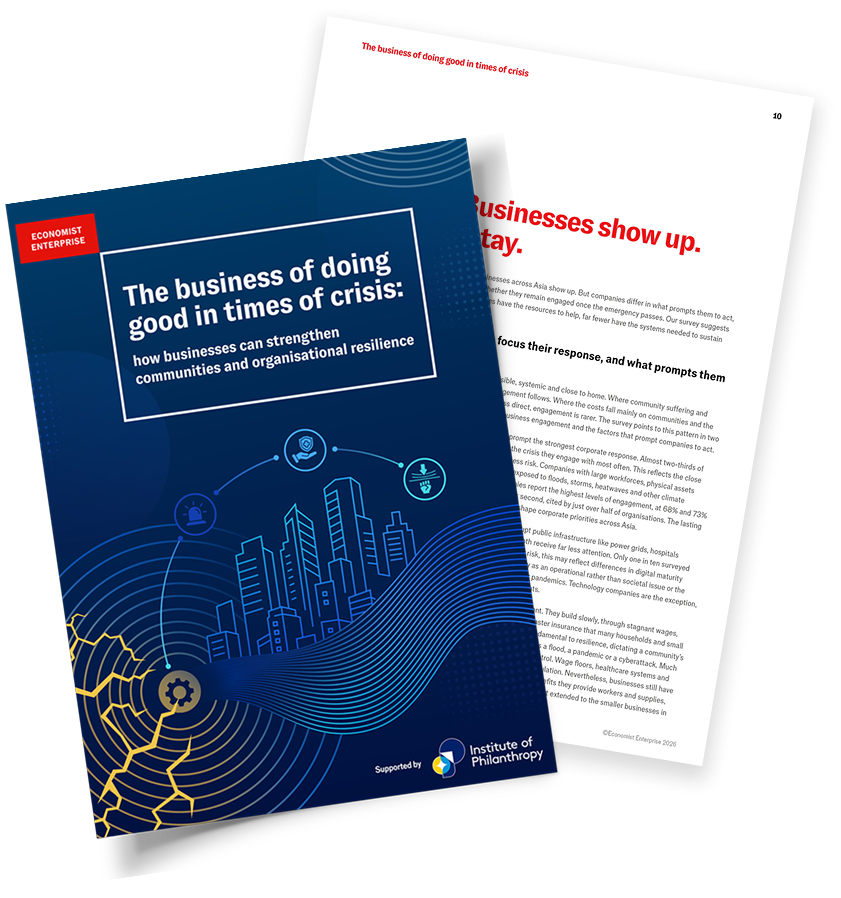
The business of doing good in times of crisis
Companies across Asia show up when crises strike. But few stay engaged long enough to support recovery and build resilience.
Businesses recover only as quickly as the communities around them. This report explores why engagement fades, what prevents companies from staying involved, and how they can use their capabilities—not just their cash—to protect operations, sustain trust and create social and business value throughout the crisis lifecycle.
Executive summary
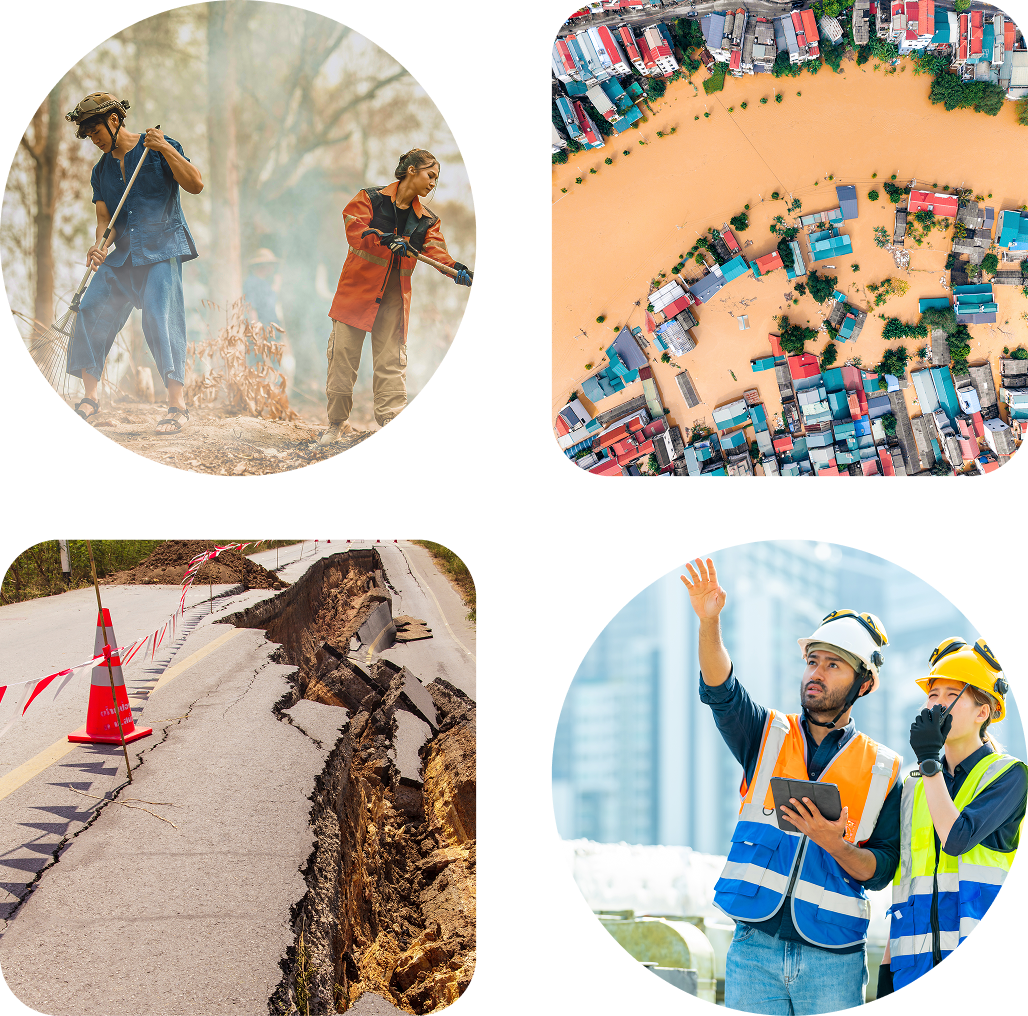
Across Asia, crises have become more frequent and more complex. Climate shocks, public-health emergencies and conflict-driven supply disruption now often overlap, making disruption a recurring feature of the operating environment rather than an exceptional event. Direct disaster losses already exceed US$200bn a year; once wider economic and environmental damage is included, the cost reaches more than US$2.3trn.1 Governments, businesses and communities all bear part of these costs, but none can build resilience alone.
Many businesses already respond when disaster strikes. The challenge is not whether they should do more, but how they can engage better: shifting from ad hoc cheques, donations and volunteering towards a more strategic positioning of the business itself, leveraging its assets, agility, capital, supply chains and expertise where they create the most value.
The case for staying engaged is both social and practical. Sustained support helps communities recover, allowing workers, suppliers and customers to regain stability sooner. It can also deepen trust with governments, customers and employees, strengthening a business’s ties to the communities in which it operates. Over time, these relationships build resilience on both sides, helping communities and businesses withstand future shocks.

What does it take to turn crisis response into lasting resilience?
Hear from experts on why businesses need to look beyond one-off donations and how their skills, resources and partnerships can help communities prepare for the next crisis.
Key findings

Business resilience depends on community resilience.
Companies rely on the communities where they operate; when crises disrupt one, they disrupt the other. Three-quarters of business leaders cite community impact as a leading reason for responding, ahead of executive preference (54%) and operational disruption (35%). Supporting recovery strengthens business resilience and helps protect a company’s licence to operate.

Businesses show up, but they rarely stay.
Companies’ crisis engagement is strongest during the emergency phase. On average, fewer than a quarter of organisations surveyed continue providing support during long-term resilience and prevention efforts. The most effective engagement is local, demand-led and sustained beyond the first response.

Photo: Beijing Sany Charitable Foundation
A company’s greatest contribution is often its capabilities, not its cash.
Money matters, but products, logistics, technology, data and skilled employees can create even greater value. Yet only 13% of companies regularly deploy their products and services, 11% their skilled employees and 9% leadership or co-ordination support. Companies have the greatest impact when they mobilise what they already do well every day.

Photo: OCHA-UNDP Connecting Business Initiative Global Meeting
Strong partnerships begin before crises strike.
More than half of surveyed organisations already work with governments, NGOs or business partners. Yet fewer than one in five have formal links to national or regional disaster frameworks. Trusted relationships built before a crisis enable faster, better co-ordinated responses and reduce duplication when disaster strikes.

Photo: Habitat for Humanity Hong Kong
Companies should judge success by outcomes, not inputs.
Many companies still measure what is easiest to count: money donated, volunteers mobilised or supplies distributed. These indicators are useful, but they reveal little about whether support helped communities recover or become more resilient. More than seven in ten surveyed organisations identify better measurement of social and business returns as a priority. Stronger evidence also helps companies direct resources where they have the greatest impact and sustain investment when budgets come under pressure.
References
- 1.UNDRR. Global Assessment Report on Disaster Risk Reduction. 2025. Available at : https://www.undrr.org/gar/gar2025

Explore findings from our survey of more than 1,600 executives across 14 Asian markets and interviews with experts. The report examines why businesses respond quickly when crises happen but rarely stay involved through recovery, what holds back longer-term commitment and how companies can build more resilient approaches to engagement throughout the crisis lifecycle.


Turn crisis response into business resilience
Assess how your organisation engages with societal crises and find the next practical step
No two companies face the same risks, resources or responsibilities. The systems they need to prepare for, respond to and recover from crises will therefore differ. This assessment helps you assess the systems your organisation already has, identify gaps and decide what to strengthen across five areas: governance, capabilities, partnerships, funding, and data and learning. You will see where your organisation sits on a crisis-engagement spectrum, how developed each system is and practical examples of what stronger engagement can look like.
The results will help you decide what to put in place first, what can wait and where your organisation can strengthen its approach. The assessment takes about five minutes to complete, and you can download your results.