
Infrascope 2025/26


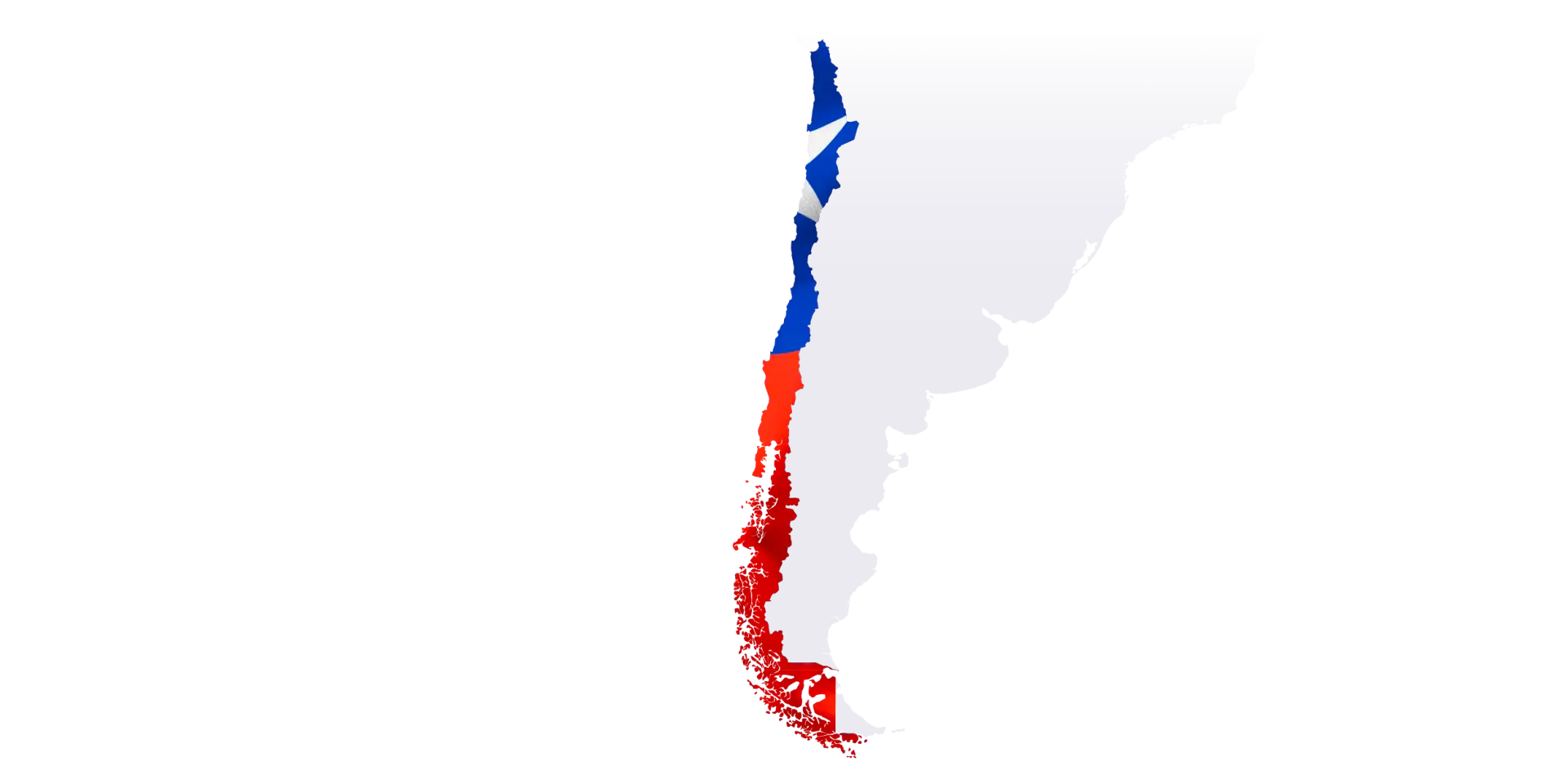
Chile
Score: 78.2
out of 100
Rank: 2nd
out of 26 countries
Chile remains one of the region’s most mature public-private partnership (PPP) markets, supported by specialized institutions and a highly developed concessions program. Continued investment in transport and social infrastructure, alongside emerging opportunities in new sectors, underscores the model’s enduring role in infrastructure delivery. Recent policy developments reflect a growing emphasis on sustainability and more systematic project planning and evaluation.

MACRO ENVIRONMENT
Population, 202519.9m
Source: The Economist Intelligence UnitGDP (US$), 2025$357.4bn
Source: The Economist Intelligence UnitSovereign risk rating, Oct 2026A
Source: S&P Global RatingsPPP INVESTMENT
Number, 2016-25*60
Source: IJ Global‡Total (US$), 2016-25$15.0bn
Source: IJ Global‡% of all infrastructure investment, 2016-25†15%
Source: IJ Global,‡ Infralatam, Economist EnterprisePPP INVESTMENT BY SECTOR (US$), 2016-25


Transport$6.6bn

Renewables$2.0bn

Energy (non-renewables)$2.1bn

Water and waste$2.2bn

Social infrastructure$2.1bn
Policies and institutions
Chile’s PPP framework remains anchored in its long-standing concessions regime, governed by the Public Works Concessions Law (consolidated in Decree 900/1996) and its implementing regulation (Decree 956/1997).1,2 The General Directorate of Public Works Concessions (DGC), a specialized agency within the Ministry of Public Works, oversees concession development, procurement and contract management, supported by dedicated technical departments.3 The Concessions Council, an advisory body within the Ministry of Public Works, reviews proposed concession projects and the DGCOP’s five-year concessions plan, providing an additional layer of scrutiny over project selection and planning.4
Recent market developments
Chile continues to maintain an active concessions market while expanding beyond its traditional concentration in transport. The Ministry of Public Works announced a 2025-26 portfolio of 15 potential concessions representing approximately US$7.9bn in investment, spanning highways, airports, rail and cable-car transport, and penitentiary infrastructure.5 Recent financial closes also demonstrate continued investment in Chile’s longstanding hospital concessions program, including approximately US$415m in financing secured for the four-hospital Los Ríos-Los Lagos portfolio in 2025.6,7 These developments build on the 2022-26 infrastructure program, which sought to broaden the concessions portfolio into areas such as desalination while sustaining investment in transport and social infrastructure.8
Political and public support
Chile’s concessions model has retained broad political support across successive administrations. The previous administration (2022-26) maintained an extensive concessions program and launched the National Public Infrastructure Plan 2025-2055, emphasizing public-private collaboration in long-term infrastructure development.9 The administration that took office in March 2026 likewise identified concessions and PPPs among its priorities, within a broader infrastructure portfolio of more than 60 initiatives.10 Support extends beyond the executive branch, with a Senate committee advocating concession delivery for specific transport projects.11 Although debate persists over highway tolls and individual concession decisions,12 this has not translated into broad opposition to the concessions model.
Notable strengths
Chile leads the region in risk management and contract monitoring, with particularly strong arrangements for risk allocation, contingent liabilities, contract management and ongoing project reporting. It also ranks 2nd in regulations and institutions, reflecting clear institutional responsibilities, a capable PPP agency and highly competitive procurement processes. Chile also ranks 2nd in performance evaluation and impact, supported by a mature project portfolio and strong monitoring of infrastructure quality, although formal ex-post evaluation remains less comprehensive.
Notable challenges
Project preparation and sustainability remains Chile’s main relative weakness, despite several strong underlying practices. Project selection lacks a formal value-for-money methodology, contributing to a 13th-place regional ranking for economic principles in project selection. Social-equity criteria also remain incomplete despite recent progress on inclusion and gender considerations. Meanwhile, Chile lacks a general PPP requirement for project-level environmental risk analysis despite some provisions for climate risk management, a notable gap in its otherwise region-leading approach to risk management.
Recent progress
Chile has made targeted progress since the previous edition, particularly in project transparency and sustainability. Since June 2025, updated procedures have required new concession projects entering the National Investment System to have standardized records and supporting documentation in its Integrated Project Bank, improving project traceability.13 The Ministry of Public Works’ 2024-30 sustainability policy has also strengthened its approach to social inclusion and gender equality in infrastructure development, while enhanced sustainability requirements in bidding documents contributed to the Alto Hospicio-Iquique cable-car project securing Climate Bonds certification for its plans and designs in 2025.14,15
Top five recommendations for progress
(ordered according to index category)
1
Establish a standardized value-for-money methodology for PPP selection
Require prospective PPPs to undergo a consistent value-for-money assessment comparing PPP delivery with conventional public procurement. Develop a standardized methodology and tool so the analysis is applied systematically across projects rather than on an ad hoc basis.
Timeline to achieve
Medium term
Difficulty to achieve
Medium
Impact on category 2: Project preparation and sustainability
Chile: current score
71.6
Score with recommendation applied
75.8
2
Formalize viability-gap funding arrangements
Build on Chile’s broader mechanisms for project-specific public financial support by developing a more systematic approach to identifying and addressing viability gaps. Clear eligibility, appraisal and fiscal-control criteria could improve the targeting of support for certain socially valuable projects.
Timeline to achieve
Medium term
Difficulty to achieve
Medium
Impact on category 2: Project preparation and sustainability
Chile: current score
71.6
Score with recommendation applied
77.9
3
Broaden social-equity criteria in PPP development
Build on Chile's progress in social inclusion and gender equality by incorporating employment creation and small-business participation more systematically into PPP identification and development. These additional criteria would broaden the social objectives considered during project preparation.
Timeline to achieve
Short term
Difficulty to achieve
Low
Impact on category 2: Project preparation and sustainability
Chile: current score
71.6
Score with recommendation applied
77.9
4
Close remaining gaps in environmental and disaster-risk provisions
Extend environmental-risk assessment requirements across PPP sectors and procurement routes, building on existing climate-resilience provisions. Strengthen contractual guidance by establishing a clear deadline for notifying <i>force majeure</i> events, complementing Chile’s existing procedures for managing such risks.
Timeline to achieve
Medium term
Difficulty to achieve
Low
Impact on category 4: Risk management and contract monitoring
Chile: current score
90.0
Score with recommendation applied
96.3
5
Strengthen systematic ex-post evaluation of PPPs
Require ex-post PPP evaluations to systematically assess realized risk allocation, economic costs and benefits, and value for money. Applying these analyses consistently, and publishing results, would provide stronger evidence on whether completed PPPs delivered the benefits anticipated during project appraisal.
Timeline to achieve
Medium term
Difficulty to achieve
Medium
Impact on category 5: Performance evaluation and impact (ex-post)
Chile: current score
55.1
Score with recommendation applied
69.0
Assessment guidance:
Short term: achievable in months (ie, straightforward activities such as procedural updates)
Medium term: up to a year (ie, moderately involved activities such as building web platforms)
Long term: more than a year (ie, time-consuming activities such as new legislation/institutions)
Difficulty/complexity: rated as low/medium/high—often mirrors the time frame, but can differ based on how technical it is, how many resources are needed and how politically challenging it is, etc.
1. https://www.bcn.cl/leychile/navegar?idNorma=16121
2. https://www.bcn.cl/leychile/navegar?idNorma=133948
3. https://concesiones.mop.gob.cl/funciones/
4. https://concesiones.mop.gob.cl/consejo-de-concesiones/
5. https://www.mop.gob.cl/mop-presenta-cartera-de-15-potenciales-proyectos-a-licitar-via-concesiones-por-una-inversion-total-de-us7-898-millones/
6. https://www.rubiconcapitaladvisors.com/news/rubicon-advises-on-the-sale-of-the-financing-of-four-ppp-hospitals-in-chile
7. https://concesiones.mop.gob.cl/uploads/sites/4/2025/09/2025_3T_vf.pdf
8. https://www.mop.gob.cl/plan-infraestructura-2022-2026/
9. https://prensa.presidencia.cl/comunicado.aspx?id=303111
10. https://planeamiento.mop.gob.cl/nuestro-primer-desafio-es-enfrentar-la-emergencia-priorizando-una-cartera-con-mas-de-60-iniciativas/
11. https://www.senado.cl/comunicaciones/noticias/piden-revertir-decision-de-ejecutar-de-manera-directa-corredores-de
12. https://www.latercera.com/nacional/noticia/de-una-buena-noticia-a-cuidar-los-intereses-de-las-concesionarias-las-divergentes-reacciones-parlamentarias-al-anuncio-de-rebaja-del-tag/
13. https://www.gobiernosantiago.cl/wp-content/uploads/2026/04/Normas-Instrucciones-y-Procedimeintos-NIP-para-el-proceso-de-inversion-publica-2026.pdf
14. https://cambioclimatico.mop.gob.cl/archivos/sites/2/2024/10/politica_de_sostenibilidad_Ministerio_de_Obras_Publicas_2024-2030.pdf
15. https://www.climatebonds.net/news-events/press-room/press-releases/el-proyecto-de-app-del-telef%C3%A9rico-el%C3%A9ctrico-de-chile-es-la-primera-certificaci%C3%B3n-de-activo-soberano-del-mundo
Infrascope 2025/26
Score 0–100 where 100 = best, rank out of 26 countries
Nascent
0 to <30
Emerging
30 to <60
Developed
60 to <80
Mature
80 to 100


