


Infrascope 2025/26


Introducing the Infrascope 2025/26
The Infrascope index is a benchmarking tool that evaluates the capacity of countries to implement sustainable, impact-driven and efficient public-private partnerships (PPPs) in key infrastructure sectors, principally transport, energy, water and sanitation, solid waste management, social infrastructure and digital infrastructure. It aims to help policymakers identify the challenges to private-sector participation in infrastructure that, if overcome, could unlock the power of PPPs and support the broader development agenda.
The Infrascope index has been published since 2009. The 2025/26 edition covers 26 countries in Latin America and the Caribbean. The analysis and content cover the period from November 2025 to March 2026.
The index was built by Economist Enterprise and is supported by the Inter-American Development Bank Group (IDB Group). The methodology was developed jointly by the IDB Group and Economist Enterprise.
Note on the 2025/26 methodology updates
As best practices, needs and information about infrastructure PPPs have continued to evolve, Economist Enterprise and the IDB Group have made minor improvements to the Infrascope's methodology to ensure continued rigor and accuracy in assessing PPP performance.
These updates affect 21 indicators, primarily through terminology clarifications, adjustments to scoring guidance and indicator placement, and revisions to data sources. As a result of these updates, retrospective revisions are also shown for the 2023/24 scores cited in this edition, ensuring a consistent reference frame for comparison between 2023/24 and 2025/26.
See the About page for a full breakdown of the updates.
Key Findings
PPP investment in Latin America and the Caribbean is trending upward
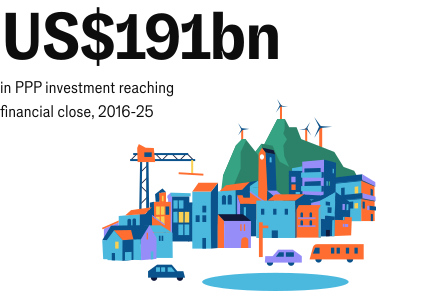
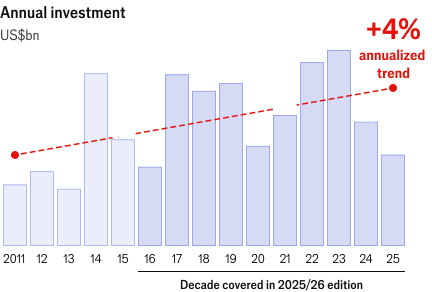
Note: Investment is based on recorded PPP transactions reaching financial close. Historical totals are subject to retrospective revisions; therefore, more recent years are likely to understate actual activity, and previously published figures are not directly comparable.
Source: IJ Global, cross-checked with the World Bank PPI database. Data may include projects that are developed under PPP, sectoral or concession laws, with differences among countries. Focuses on greenfield and brownfield projects; excludes asset acquisition, company acquisition, securitization and refinancing transactions.
PPPs are expanding into a wider range of infrastructure sectors
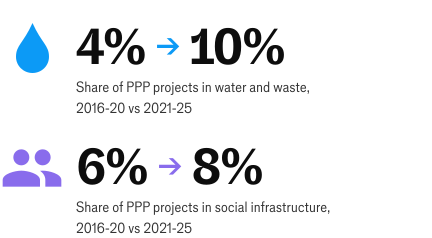
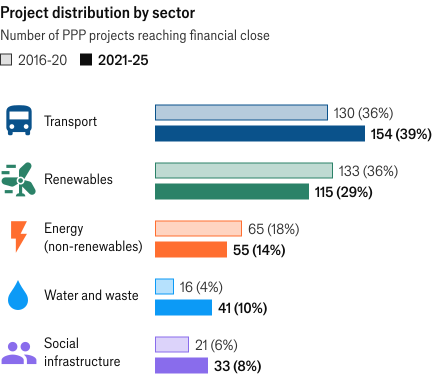
Note: Telecoms projects account for a negligible share and are excluded from this visual.
Source: IJ Global, cross-checked with the World Bank PPI database. Data may include projects that are developed under PPP, sectoral or concession laws, with differences among countries. Focuses on greenfield and brownfield projects; excludes asset acquisition, company acquisition, securitization and refinancing transactions.
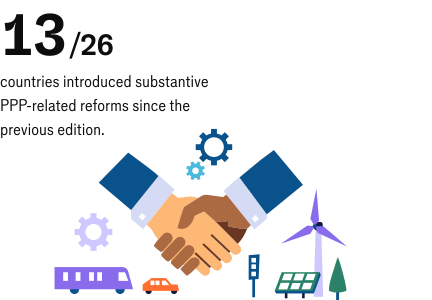
PPP reforms are reaching further across the project lifecycle
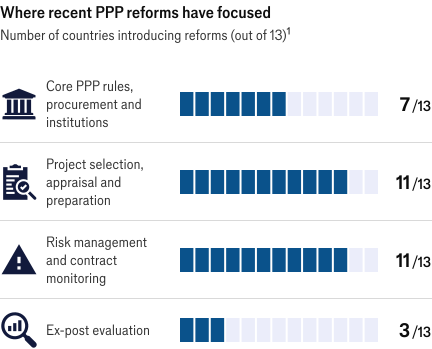
1. Reform areas overlap; countries may be counted in more than one group.
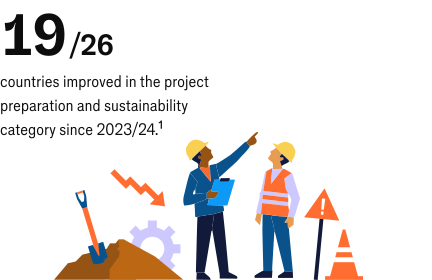
PPP preparation is becoming more systematic, but practical support still lags
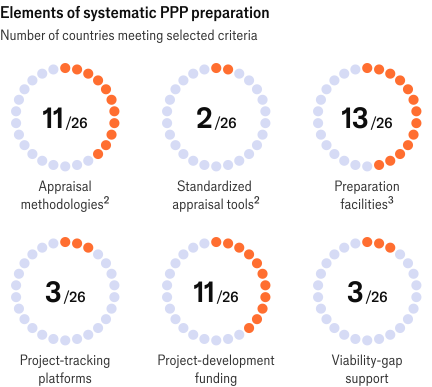
1. Note: only selected elements of this category are depicted here. 2. Appraisal methodologies and standardized tools are counted where countries meet the criteria for at least two of three core assessments: cost-benefit analysis, fiscal affordability and value for money. 3. Preparation facilities and project-development funding refer to the availability of specified mechanisms, not their consistent use across projects.
Capital costs are easing as infrastructure financing gradually expands
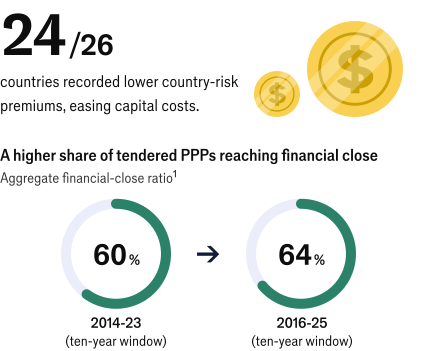
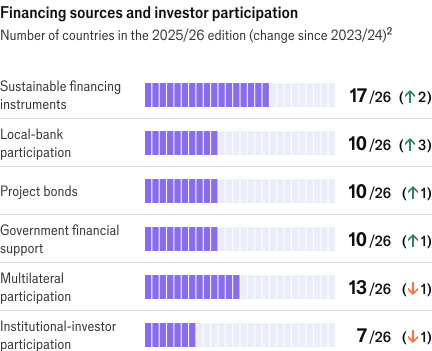
1. The financial-close ratio compares projects reaching financial close with projects entering tender during each ten-year period; the two groups do not necessarily comprise the same projects. 2. Financing indicators cover the past five or ten years, and include both general infrastructure financing and PPP-specific measures. See the full report for definitions.
Basic sustainability safeguards are common, but major shortcomings remain
Number of countries meeting selected criteria
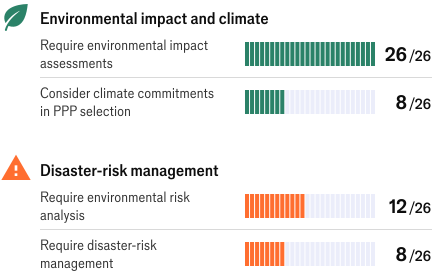
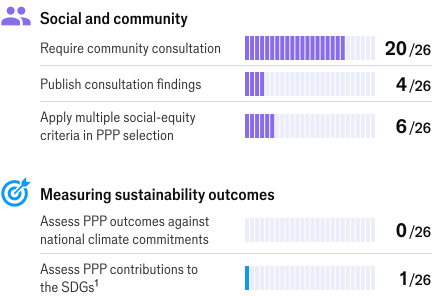
1. SDGs = Sustainable Development Goals.
Ex-post evaluation remains fragmented, limiting opportunities to learn from PPP outcomes
Number of countries meeting selected criteria
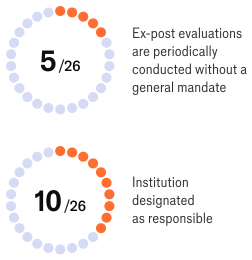
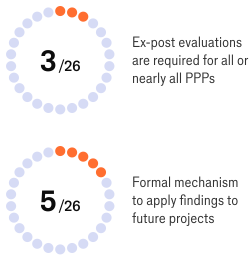
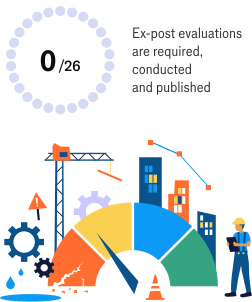
These components do not necessarily occur in the same countries. The third criterion requires demonstrated evaluation and online publication.
Download report

Overall performance
Score 0–100 where 100 = best, rank out of 26 countries
Nascent
Emerging
Developed
Mature


The index evaluates readiness and capacity by dividing the PPP enabling environment into five components:
- Regulations and institutions
- Project preparation and sustainability
- Financing
- Risk management and contract monitoring
- Performance evaluation and impact (ex-post)
Strong performance in the first category has laid the groundwork for countries seeking to implement successful infrastructure PPP programs. Now priorities must evolve to focus more on the preparation, financing, management and evaluation of PPPs.
Use the tool below to explore the index results within each category.
Performance across the Infrascope index
Score 0–100 where 100 = best, rank out of 26 countries
Nascent
Emerging
Developed
Mature


Recent progress
Score 0–100 where 100 = best, rank out of 26 countries
Nascent
Emerging
Developed
Mature
Since the 2023/24 Infrascope, performance has improved in 16 of the 26 countries
Significant improvements have been made in several markets, including Ecuador, Guatemala and Paraguay.
In general, score changes are driven by a variety of factors, including government support for PPPs, policy and institutional updates, trends in PPP financing and evolving risk environments, among others.
Highlight a country for more details on how its scores have changed.
Case studies

Building bankable PPPs in Ecuador
Ecuador is reforming its PPP framework to turn infrastructure ambitions into viable investments. With stronger project preparation, clearer approval processes and greater fiscal oversight, its emerging pipeline will test whether institutional reforms can translate into successful transactions.

PPP framework reform in Guatemala
After more than a decade of limited PPP delivery, Guatemala has overhauled its legal and institutional framework. The reforms seek to overcome longstanding bottlenecks in project preparation and approval, offering lessons on turning infrastructure pipelines into investable projects.

Water PPPs in Latin America
As Latin America seeks to expand water and sanitation infrastructure, PPP contracts are evolving to place greater emphasis on service performance. Experiences from Peru, Chile and Brazil highlight how payment mechanisms, risk allocation and effective monitoring and enforcement can shape project outcomes.

Education PPPs in Brazil and Uruguay
Brazil and Uruguay are demonstrating how PPPs can expand and maintain school infrastructure while keeping education under public control. Their experiences offer lessons in allocating responsibilities, securing long-term financing and linking private-sector payments to the quality of facilities.

Health PPPs in Latin America
As health PPPs gain momentum across Latin America, Chile and Brazil offer contrasting approaches to hospital infrastructure and service delivery. Their experiences highlight the importance of performance monitoring, payment incentives and contract design in ensuring accountability and delivering value for money.

