

Few firms are as sprawling and as decentralised as LVMH. The world’s largest luxury group oversees 75 brands, or maisons, which Bernard Arnault, its founder, brought together to wield the power of scale with advertisers, landlords and suppliers. Yet he kept maisons autonomous to guard the identity and craft that make each valuable and desirable. That structure has helped turn LVMH into a €250bn ($291bn) behemoth, but it also makes group-wide initiatives, such as adopting artificial intelligence (AI), no simple matter. The group’s approach to AI, though, is instructive: it shows how firms, small or large, can use AI to sharpen their competitive edge without blunting what makes them special.
LVMH has not resisted AI, nor has it rushed to deploy it. The luxury giant roots the technology in the goals of each maison, avoiding the mistrust that often afflicts digital transformations. It recognises that people are at the core of how it creates value and chooses to use AI to bolster its human strengths. The group wields its size to learn cheaply by piloting AI projects with its bigger maisons, codifying what works and sharing the successes across the group. Put together, its efforts result in a measured use of AI that offers a counter-narrative to Silicon Valley’s creed that the technology brings disruption. LVMH knows what makes it distinctive, uses AI to deepen that edge and lets success grow before scale does.
Let the AI model meet the business one
When Gonzague de Pirey joined LVMH to focus on the use of AI within the group, he knew that in a firm whose maisons bet on heritage and craftsmanship, a top-down technological mandate would be met with resistance. Instead, he chose to “stop advocating” for generic AI use and instead “listen to the business priorities”. It led, he says, to “a complete change of mindset” that allowed his team to work “extremely smoothly” with each maison.
The idea is simple: prove the value of the technology by advancing the strategic interests of each maison. And by doing so, you sidestep the resistance that often arises when AI is poorly understood and its use is distrusted. According to a 2025 survey by the Institute of Directors, an organisation for business leaders, about half of British bosses say that limited understanding of AI and low trust in it are the two biggest hurdles in adopting the technology.

Once AI was broadly trusted, LVMH had to make it reliable. That became possible thanks to an investment LVMH made long before the advent of AI: the digitisation of its client data. “The big effort,” says Mr de Pirey, “was to pull all our client data into a common, secure infrastructure.” That shift from dispersed records to a unified system created the foundation for AI across the group.
What followed was a sober assessment of which AI projects to pursue, weighing impact against effort. Like many firms, though, LVMH had to navigate the productivity J-curve, where returns from AI often fall before they rise as companies invest in the data, processes and skills that make the technology effective. In practice, says Mr de Pirey, the AI part is easier: “Our AI Factory”—a team of machine-learning engineers—“can crank up an algorithm” to meet a maison’s brief and quickly ready it for roll-out, “but it’s the real-life deployment that takes time and money.” And yet he adds a warning that unlike traditional IT, running generative AI models brings continuing financial and environmental costs that cannot be wished away.
“We stopped advocating for AI and started listening to business priorities. That shift made adoption smooth across the maisons.”
Gonzague de Pirey
Chief omnichannel and data officer, LVMH
Chief omnichannel and data officerLVMH
Know what you do best and do it better
Not many firms worth a quarter of a trillion euros speak of “sustaining savoir-faire” when doing business. LVMH does, and also applies the principle to AI. In practice, this means adopting the technology while keeping creation in the hands of designers and artisans as well as giving client advisers the time and tools to serve clients better.
The question of replacing people with AI was never posed at LVMH. Luxury is “primarily a human thing,” says Mr de Pirey, so at LVMH, technology is always in service of “the space for human connection”. In customer service over the phone, for example, LVMH chooses to use AI to lift quality rather than lower costs. An AI-powered system pulls any information an adviser would need, sparing them minutes of rummaging and letting them spend more time serving clients. Against the AI-spurred race to make call centres slimmer, LVMH is happy for its advisers to tell the story of a new creation, with the technology ensuring that the story is told better.
But most LVMH sales take place in boutiques, where time spent with clients is a measure of care, says Mr de Pirey. AI helps extend that time by trimming the time advisers spend on routine tasks. An algorithm on LVMH’s retail app, for example, helps each adviser identify their “very important clients” (who generate much of the group’s sales) and reduces the time spent drafting those clients personalised messages while also improving eloquence. The saved time is then reinvested in spending more meaningful time with clients. Not every firm trades on lore, but many trade on service; LVMH shows that improving it may be better business than cutting wages.

The use of AI in LVMH’s creative processes also reflects what the group values—that creatives have the freedom to direct their work—and this includes how, if at all, to use the technology. Respecting this principle, Mr de Pirey sees AI use for creativity “almost like an R&D effort”. There is no business goal to create “faster” or “cheaper,” he says, so the AI Factory can only support maisons that are “more curious to experiment” in the hope that its efforts could “disturb the process of creation” in a positive way.
Not every company can afford such freedom; LVMH’s values are unusual, and its margins exceptional. But the broader point is that building an “AI-ready culture” matters less than bending it to fit what actually makes a business valuable. For LVMH, that means advisers who connect with clients and designers who can create without compromise. For others, it will mean something else. The test is whether adopting AI enhances what sets the firm apart, or erodes it. A company that sacrifices its edge to fit the technology will find the bargain a poor one.
“Luxury is primarily a human thing. AI’s role isn’t to replace that—it’s to serve our values and create more space for human connection.”
Gonzague de Pirey
Chief omnichannel and data officer, LVMH
Chief omnichannel and data officerLVMH
Scale once proven
At LVMH, experiments with AI start at the top. “When a solution is not ready yet,” explains Mr de Pirey, “we prefer to co-develop it with a big maison. They have resources, they can test, they can hire.” Once an AI tool is proven, it is turned into a packaged solution—complete with measures of likely impact—that smaller maisons can then adopt. It is a generalisable playbook: pilot AI where capacity exists; codify; then scale.
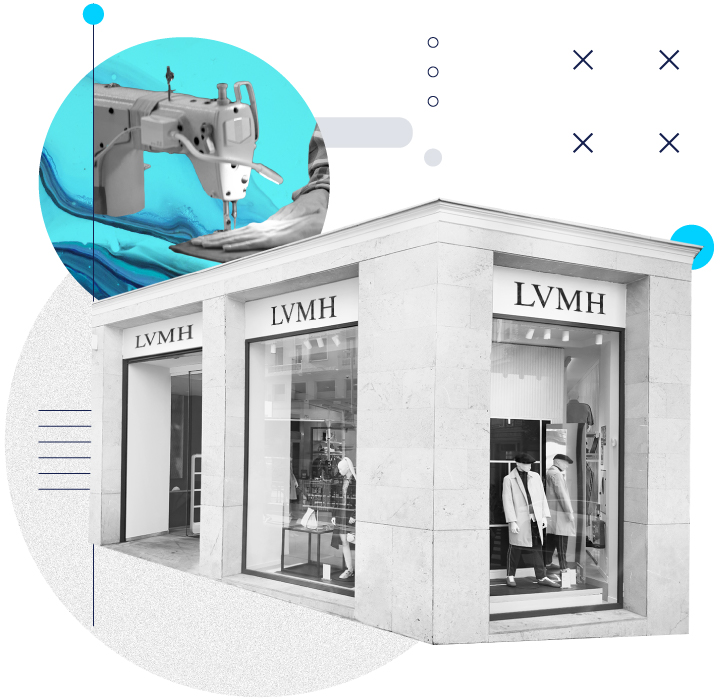
The benefits are clear: “the impact is bigger if the maison is bigger,” says Mr de Pirey. And the risks are minimised: larger maisons bear the pain of early mistakes, while smaller ones are spared from the costs of trial and error. But the strategy is not without pitfalls. Too sharp a division between maisons could breed dependence, or a two-speed group. LVMH counters this by emphasising that the aim is not uniformity but, as one of its other business-model pillars would have it, “synergies with respect for the identity and independence of the maisons.”
Having 75 brands to spread innovation across is a luxury few can afford. Yet the broader principle of LVMH’s approach to AI scales: use the stronger arms of the business to test what is uncertain, then share the lessons in a way that strengthens the whole without flattening local differences. For firms juggling AI adoption across multiple departments or markets, getting the balance between shared strength and preserved autonomy right may be as valuable as the tech itself.
Building AI-ready firms
Flat-packs helped make IKEA the world’s largest furniture-maker, and the firm is now using the same approach to AI, showing how even the smartest algorithms work better when everyone has a hand in tightening the bolts. Building AI-ready firms, the first instalment of the Enterprise AI in action series, also includes an article describing what Erik Brynjolfsson, a leading economist of the digital age, thinks it will take for a firm to gain from the technology, and an article on how LVMH, the world’s largest luxury group, is using AI to strengthen its distinctive character.
Sources
Institute of Directors. Major blockers to AI adoption in British business. April 28 2025. Available at: https://www.iod.com/news/science-innovation-and-tech/major-blockers-to-ai-adoption-in-british-business/


