
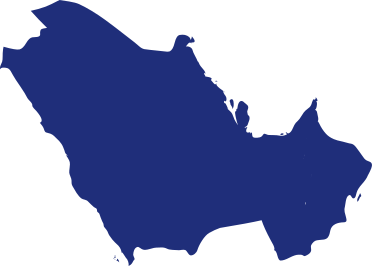

The Gulf Co-operation Council (GCC) enters 2025 grappling with heightened geopolitical conflicts, shifting trade routes and an ongoing push for economic diversification. Amid these challenges, some countries in the region could play a critical role in global trade as geopolitically non-aligned partners. By leveraging its non-aligned position and deepening existing trade ties, the GCC can mitigate economic risks while bolstering its economic growth. However, achieving this balance is fraught with structural challenges that could hamper the region’s long-term success.
Grappling with geopolitical disruptions
Recent conflicts, including the Israel-Hamas war and attacks on Red Sea trade routes, have disrupted supply chains. The Red Sea crisis, in particular, has increased shipping costs and delayed transit times as shipments are rerouted around the African continent. High costs costs are a major concern for executives in the region: 44% stated that high inflation was the top source of pessimism for the global trade outlook over the next two years—a significantly higher rate than the global average of 33%. Sandeep Sharma, the director of group procurement at Alamar Foods (the operator for Domino's Pizza in the Middle East and North Africa), emphasises the need for agility and decentralisation in decision-making, given the unpredictability of global supply chains.
In response to escalating conflicts in the region, 43% of the GCC firms we surveyed are diversifying their supplier sources. This aligns with another finding from our survey: GCC firms show a stronger preference for working with more suppliers than firms in other regions (81% of GCC companies vs 75% globally). “There was a time when supplier loyalty was a big thing,” says Mr Sharma, “but in today's scenario, I’d want to cluster my supply chain in terms of the geopolitical situation. If I've got one supplier in the US, I want another supplier in Europe.” He points to a growing reliance on new suppliers from the GCC and South Asia, mainly by firms based in India, Pakistan and Egypt. However, expanding supplier bases often comes with challenges, particularly in markets where corporate governance is less robust. These include some emerging markets where regulations are still developing or are inconsistently applied, to politically unstable regions and those with large informal economies. “So [expanding your supplier base] depends upon how many relationships you can manage properly,” Mr Sharma adds.
As GCC firms expand their supplier bases they are sourcing new suppliers from within the region. About 34% of executives in the GCC are regionalising, compared with 22% globally. This is motivated by a desire to reduce transport and logistics costs (33%) and times (31%). These factors have become increasingly important amid escalating regional conflicts and their impact on the Suez Canal—a critical gateway for imports from Europe in particular. However, regionalisation may also present risks, such as over-dependence on nearby markets that might be vulnerable to political or economic instability. The ongoing crises in the region, such as the Israel-Hamas war and disruptions to Red Sea trade routes, underscore how quickly local conflicts can escalate and affect neighbouring economies. This interconnectivity increases the vulnerability of regional supply chains, where even minor disruptions can ripple through multiple markets, amplifying risks for businesses that are reliant on such networks.
About 23% of executives in the region are reshoring. Efforts to localise sourcing are part of Vision 2030 initiatives, according to Asif Salam, professor of marketing and supply-chain management at King Abdulaziz University in Saudi Arabia. “Instead of depending on offshore suppliers, they're trying to [regionalise] supply chains to mitigate disruptions and achieve resilience,” he says. “[For instance] in car manufacturing, they are focusing on assembly now, but eventually they will try to in-shore or near-shore the rest of the supply chain.” However, as Mr Salam notes, Saudi Arabia has recently implemented a policy that requires multinationals to move their headquarters or regional office into the country as a part of requirements to operate locally. Companies that fail to comply will be barred from operating in the Kingdom, losing access to a key regional market.
The non-aligned advantage
The United Arab Emirates (UAE) and Saudi Arabia stand out as “non-aligned” hubs amid growing global polarisation. By maintaining their neutrality and engaging with both Western and Eastern blocs, they facilitate critical supply-chain links. GCC executives we surveyed recognised the benefits of staying neutral, citing attracting foreign direct investment (FDI) (42%) and the potential for export growth with members of both blocs (37%) as the main motivations for this.
The region’s neutral status also presents an opportunity to establish favourable free-trade agreements (FTAs), according to 36% of executives. FTAs offer stable frameworks for business operations, boosting investor confidence and deepening economic ties. The UAE began establishing bilateral FTAs as part of its Comprehensive Economic Partnership Agreements (CEPA) strategy. Among the most recent is its FTA with Australia, signed in November 2024, which eliminates tariffs on over 99% of Australian exports to the UAE, including key agricultural products.2 This agreement is expected to enhance bilateral trade and investment, particularly in sectors such as critical minerals and clean energy. A similar agreement signed with Vietnam in October is expected to facilitate greater market access and economic co-operation. Saudi Arabia has been involved in FTA negotiations with the UK, New Zealand and Indonesia through the GCC. Strengthening the GCC bloc as a whole could boost each country’s negotiating power in these agreements.
However, the dynamics of the GCC bloc are being tested. It was emerging as the most effective regional co-operative organisation in the Arab world after establishing projects like the customs union and common market. But Saudi Arabia's implementation of import restrictions in 2021 posed questions about the objectives of the GCC customs union, which include eliminating tariff and non-tariff barriers to facilitate intra-GCC trade. The current economic strategies of Saudi Arabia and the UAE may further test alignment within the trade bloc.4 Differing economic priorities along with concerns about maintaining balanced leadership within the regional bloc have slowed deeper integration. As such, the GCC's ongoing FTA negotiations with other nations such as China, Japan and the UK may face hurdles.5 Diverging priorities between the two nations may hinder the region's capacity to regionalise supply chains.
Going global
In order for the UAE and Saudi Arabia to cement their positions as trade hubs, executives believe that strategic partnerships with international companies are fundamental. Established home-grown businesses are looking to expand overseas while regional governments are attracting FDI to diversify their economies. The UAE’s non-oil trade surged by 14.4% year-on-year in 2023, and Saudi Arabia’s Vision 2030 programme continues to channel investments into manufacturing, tourism and logistics.6 Robust global trade networks will remain crucial to the success of these economic diversification and growth initiatives. Economic stability and growth was the top source of optimism for the global trade outlook for 39% of the GCC executives we surveyed.
Digitalisation is also streamlining trade. Over the past few years, Abu Dhabi and Dubai have accelerated the development of their digital single windows which has reduced processing times significantly. Such institutional efforts will complement corporate technology integration and enable data-driven supply-chain management. "Real-time visibility and AI-driven predictive analytics allow for optimised decision-making, from inventory to customer demand forecasting," explains Mr Sharma. As both Saudi Arabia and the UAE continue to drive economic transformation, competition between the two countries will increase.
At a crossroads
The GCC countries’ trade strategies reflect a blend of resilience, adaptability and ambition. The UAE and Saudi Arabia’s non-aligned stance, in particular, has positioned them as pivotal hubs for trade and investment. As Mr Salam summarises, "Resilience lies in balancing economic interests and geopolitical neutrality—a lesson the GCC is teaching the world." However, as conflicts and rivalries in the region intensify, they risk spilling into neighbouring countries, threatening to stifle regional interconnectivity and thereby reducing the region's attractiveness as a supply-chain hub.
- 1Note: only executives in the UAE and KSA were surveyed as part of the research programme, while the GCC comprises Bahrain, Kuwait, Oman, Qatar, Saudi Arabia and the United Arab Emirates.
- 2Department of Foreign Affairs and Trade, "Australia-UAE Comprehensive Economic Partnership Agreement (CEPA) - Key Benefits to Australia," 2024. Available at: [https://www.dfat.gov.au/trade/agreements/not-yet-in-force/australia-uae-comprehensive-economic-partnership-agreement-cepa/australia-uae-cepa-key-benefits-australia#:~:text=in%20Australia%20ambitions.-,Goods,UAE%20has%20agreed%20to%20date]
- 3Carnegie Endowment for International Peace, "The Future of the Gulf Cooperation Council Amid Saudi-Emirati Rivalry," 2023. Available at: [https://carnegieendowment.org/research/2023/10/the-future-of-the-gulf-cooperation-council-amid-saudi-emirati-rivalry?lang=en]
- 4Ibid.
- 5Ibid.
- 6Arab News, "UAE's non-oil sector continues to grow despite geopolitical challenges," 2024. Available at: [https://www.arabnews.com/node/2462106/business-economy#:~:text=Furthermore%2C%20the%20UAE's%20non%2Doil,the%20second%20half%20of%202022]
