


Thailand and BIMSTEC advance global trade connectivity
As trade routes passing through South Asia grow in political and economic importance, 2025 BIMSTEC summit host Thailand is strengthening the region’s links with its neighbours and the world
Geopolitical shifts and global supply-chain disruptions have reshaped trade in the past half-decade, highlighting the importance of shipping lanes that run through the Indian Ocean to connect Asia with Africa and Europe. South Asia’s influence is rising: India is forecast to overtake Japan to become the world’s fourth-largest economy in 2025, and South Asian countries are projected to be major contributors to global growth.
Since its establishment in 1997, a regional trade grouping that straddles South and South-East Asia has been preparing to exercise that influence co-operatively and for the global good. With its name now standing for the Bay of Bengal Initiative for Multi-Sectoral Technical and Economic Cooperation, BIMSTEC unites Bangladesh, Bhutan, India, Myanmar, Nepal, Sri Lanka and Thailand.

Prioritising sustainable development and connectivity
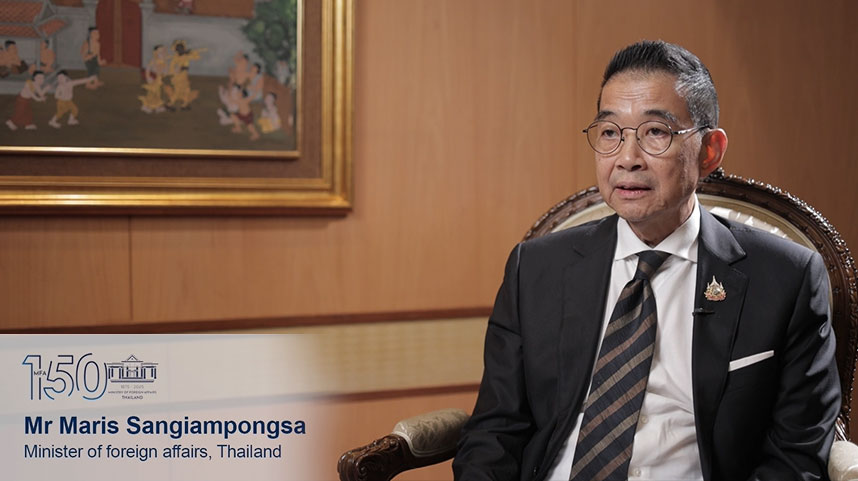
The organisation follows a broad agenda to promote security and sustainable development—along with peace, prosperity and resilience—not just in its neighbourhood, but worldwide. These priorities were updated and formalised at the Sixth BIMSTEC Summit, held on April 4th 2025 in Bangkok. As the host country, “Thailand would like to revitalise activities among countries in BIMSTEC,” says Maris Sangiampongsa, the Thai minister of foreign affairs.

“Thailand would like to revitalise activities among countries in BIMSTEC.”
Maris Sangiampongsa Minister of foreign affairs, Thailand
A central achievement of the summit was the Sixth BIMSTEC Summit Declaration, which expresses aims such as reaching a BIMSTEC Free Trade Area Agreement, encouraging member countries to explore a cross-border payment system and the settlement of trade in local currencies, and investing in port infrastructure and logistics.
Transport by sea and land is part of the connectivity portfolio taken on by Thailand, chair of BIMSTEC from 2022 to 2025. Under BIMSTEC’s distinctive functional leadership model, member countries are responsible for particular sectors. So, for example, India is taking the lead on security, and Bhutan on environment and climate change.
“One of the areas we discussed a lot at the summit was maritime and multimodal transport,” says Mr Sangiampongsa. The event saw the signing of the BIMSTEC Agreement on Maritime Transport Cooperation, a framework to reduce logistical bottlenecks and deepen economic integration. In Thailand, a key initiative is to upgrade Terminal F at Laem Chabang Port. This is part of the Eastern Economic Corridor, a special economic zone in three coastal provinces east of Bangkok, which acts as a gateway to the fast-developing markets of South Asia and beyond.
Complementing upgraded ports, the India-Myanmar-Thailand Trilateral Highway—currently around 70% complete—will open the way for further road links from BIMSTEC members to Cambodia, Laos and Vietnam via Thailand. “Thailand is a member of ASEAN, ASEAN Plus China, Japan and Korea, and BIMSTEC,” Mr Sangiampongsa highlights. “We are sitting in a strategic location where we can link 4bn people together.”

“We are sitting in a strategic location where we can link 4bn people together.”
Maris Sangiampongsa Minister of foreign affairs, Thailand
Thailand is also involved in a BIMSTEC project to connect around 3,000km of power grid between Thailand, Myanmar and India, reducing power costs and increasing reliability. As the country works towards achieving 50% renewable energy production by 2040, grid interconnections will increase the availability of green energy to BIMSTEC countries, broadening the reach of Thailand’s “bio-circular-green” (BCG) economic model.
Building closer links between BIMSTEC and the world
Thailand’s work to advance the BIMSTEC agenda by improving connectivity is part of its wider engagement with international economic groupings. “Thailand is a key member of several regional and subregional organisations like ASEAN, APEC and BIMSTEC, and we are working towards becoming a member of the OECD and BRICS,” the minister says. “Thailand is a country of friendship,” he points out. “We are friends to every country.”
Thailand joined BRICS as a partner this year, and will attend the BRICS Summit in Rio de Janeiro on July 6th-7th 2025, alongside fellow BIMSTEC member India. In the lead-up, Mr Sangiampongsa joined a foreign ministers’ meeting in Rio, convened by his Brazilian counterpart, on April 29th. Participants focused on how countries of the global south can strengthen international co-operation for inclusive and equitable development. “We would like to see more participation of developing countries in international forums to share their core values,” he says. Mr Sangiampongsa affirmed Thailand’s commitment to working with BRICS on education, public health, climate change and business links.
“We would like to see more participation of developing countries in international forums to share their core values.”
Maris Sangiampongsa Minister of foreign affairs, Thailand
Thailand is also likely to be the first BIMSTEC member to join the OECD. On June 3rd in Paris, the minister attended the OECD Ministerial Council Meeting as an accession country for the first time. “In the process of becoming a full member of the OECD, we will upgrade our standards and best practices,” he says. “This is expected to add 1.6% to our GDP.” In addition, Thailand hopes to bring new perspectives to the organisation: “Developing and developed countries should sit down and find common ground.”
