
We are in a new era of work. The covid-19 pandemic has profoundly changed where, when and how we work. In addition, disruptive technologies such as artificial intelligence (AI) are expected to further transform the traditional paradigm of workforce, work and workplace at an exponential rate. As part of the Making hybrid work human programme, Economist Impact’s 2021 global survey found that of the 70% of respondents who worked fully in-person before the pandemic, 72% had shifted away from traditional work arrangements. As a result, connection, collaboration and creation in the workplace are being reimagined, and achieving the right balance between organisational objectives and employee wellbeing is becoming more important than ever. The key to success in the new era of work lies in prioritising people and placing them at the centre of how and where work happens.
People at the core: the new era of work

Flexibility is key to organisational success
Coming out of the pandemic, hybrid work has come to mean more than splitting the work week between home and the office. It has also allowed workers more flexibility in how they distribute their hours around other commitments and obligations.
Rather than merely transitioning from pandemic remote work to pre-pandemic office work, hybrid work is catalysing the shift towards flexible work.
This shift to flexible working models often involves offering flexibility in when, where and how work is done.1 “It is about [adopting] new ways of working that focus on building a trust-based, purpose-driven, employee-first workplace,” says Fang Ruan, leader of the people and organisation practice at Boston Consulting Group.
Across the globe, trials of different flexible work models are under way. For example, under the four-day work week model, co-ordinated by 4 Day Work Week Global, employees can choose an extra day off during the traditional five-day work week. As a result, organisations can adapt to work more efficiently and nimbly since the team might not be working with a full staff on any given day.2
Other organisations are experimenting with the “work anytime, anywhere” model. At GBG, an identity verification and fraud prevention company, employees can work anywhere they choose for 13 weeks each year, as long as they can perform their role effectively and legally. Salaries are paid subject to the employee’s “home” country, resulting in reduced tax complexities.3
Frontline workers are also starting to reap the benefits of flexibility that were previously unavailable to them. Gap, a US clothing and accessories retailer, implemented a smartphone application that provides shift workers with greater control over their schedules. phone application that provides shift workers with greater control over their schedules. Gap started the practice of posting schedules two weeks in advance, eliminating the previous system of “on-call” shifts, which could be cancelled at any time, even up to two hours before. What's more, workers can now easily request a shift swap with other employees through the smartphone app.4
As such, flexible work is increasingly becoming a critical component of corporate, environmental, social and governance and diversity, equity and inclusion strategies5. Since talent can be recruited from anywhere, organisations recognise that they can access a more diverse pool of potential candidates, as well as enhance the work experience for existing employees of colour. By allowing employees to work remotely, organisations can downsize their office spaces, leading to lower energy consumption and fewer emissions associated with workers’ commutes.6,7
As leaders explore the best working arrangements for their organisations, they must also navigate economic storms. As a global recession looms large, executives are faced with a perceived trilemma: choosing between reducing costs, acquiring talent or offering flexibility in order to remain competitive. This could potentially disrupt the trajectory towards flexible work. As per a recent survey sponsored by LinkedIn, 68% of executives believed the current economic instability could force their companies to undo at least some of the progress made towards flexible working since the pandemic.8 However, experts interviewed by Economist Impact believe that through economic booms or busts, flexibility is here to stay. Ultimately, 2023 will be a testing ground for the new era of work.
Reimagining connection, collaboration and creation in the workplace
As organisations explore various flexible work models, traditional notions of connection, collaboration and creation are also subject to transformation.
To achieve employee wellbeing, productivity and retention, organisations must establish a deep sense of connection between the workplace and their employees, fostered through personal and professional bonds with colleagues and superiors. With distributed teams, flexible schedules and hybrid arrangements, the days of serendipitous hallway encounters are no longer guaranteed.9 Instead, they have been reconfigured in a virtual environment or recreated through mandatory in-person days, off-sites or social gatherings. Those working flexible schedules often experience a sense of disconnection—a lack of candid office conversations and reduced face time with co-workers has resulted in departmental silos, isolation, and a weakened sense of belonging and community. In Economist Impact’s 2021 survey, 57% of respondents felt disconnected from their organisations and co-workers. This requires urgent attention if flexible work is to become the enduring, new normal.
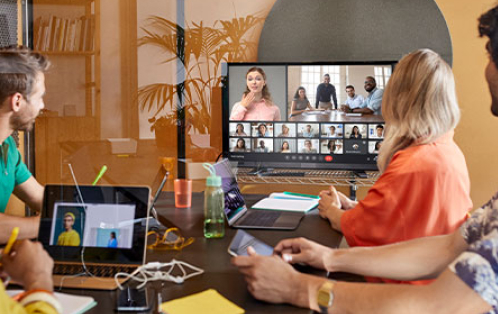
The shift towards flexible work has altered traditional in-person collaboration methods. In the 2021 survey, 57% of respondents were frustrated by the limited ability to collaborate with team members. Collaborating on projects or tasks with colleagues from different teams or roles, each with their own specialised expertise, now requires an additional layer of scheduling, virtual meetings or online tools (such as chats or digital documents). As work becomes more asynchronous, tech tools increasingly provide solutions that enable colleagues to collaborate from anywhere and at any time. These tools are necessary to compensate for the declining informal interactions between teammates, which increases the risk of miscommunication and lack of accountability, leading to decreased productivity.10
Finally, creation, or how we innovate together is being revolutionised. Technology has changed not only our collaboration processes—but our everyday tasks that impact worker creativity. Increased investments in remote control centres and other technology tools have afforded flexibility to frontline workers and also freed up their time, which can instead be more devoted to innovation and co-creation.11 However, despite this significant investment in new technology to improve our real-time collaboration and co-creations, ease of use and proper training are crucial. Without these factors, worker productivity and return on innovation can be adversely affected.12
Disruptive technologies like generative AI also have a significant role to play in the new era of work, helping employees create, connect and collaborate in new ways, whether it’s drafting an email or presentation, or summarising a document. Our research concludes that humans should stay at the centre of the creative experience as AI models continue to learn and iterate. Experts that Economist Impact interviewed predict generative AI will initially make small contributions, such as helping employees streamline time-consuming and repetitive tasks, creating a more enjoyable work experience and leading to greater job satisfaction. Additionally, AI may serve as a quality check, potentially driving up productivity.
Are employers ready for the new era of work?
The 2021-22 Making hybrid work human programme identified best practices for creating sustainable and flexible work models such as inclusive work policies, adaptive management styles and continuous employee-centric iteration of flexible working arrangements.
Expanding on these findings, Economist Impact, supported by Google Workspace, is conducting a follow-up programme to better understand the adoption of new working models, the evolution of workplace practices and the impact of technology on both. Year 2 of the programme will be built upon a global executive survey, expert interviews and desk research. This will include a barometer that allows executives to benchmark their organisations against their peers. The barometer will enable them to measure their progress on adopting and implementing flexible work models and how much their organisations are fully benefiting from the transition. The assessment report, expanding on barometer findings, is scheduled to be published later in 2023.
- 1. https://www.mckinsey.com/capabilities/people-and-organizational-performance/our-insights/the-organization-blog/three-types-of-modern-flexibility-todays-workers-demand
- 2. https://www.4dayweek.com/ukpilot
- 3. https://www.worklife.news/technology/remote-first-wfa-nine-day-weeks-flexible-working-experiments-of-2022/
- 4. https://hbr.org/2017/12/how-the-gap-used-an-app-to-give-workers-more-control-over-their-schedules
- 5. https://hbr.org/2022/02/why-flexible-work-is-essential-to-your-dei-strategy
- 6. https://doi.org/10.1038/s41558-020-0797-x
- 7. https://taskade.medium.com/introduction-the-close-connections-between-seemingly-unrelated-trends-d5f4da462151
- 8. https://www.cnbc.com/2022/11/02/is-the-era-of-flexible-working-over-linkedin-data-shows-it-might-be-.html
- 9. https://hbr.org/2022/02/5-challenges-of-hybrid-work-and-how-to-overcome-them
- 10. https://doi.org/10.5465/ambpp.2017.11496abstract
- 11. https://www.mckinsey.com/industries/metals-and-mining/our-insights/remote-operating-centers-in-mining-unlocking-their-full-potential
- 12. https://doi.org/10.5465/ambpp.2017.11496abstract
Explore more
How do your flexible working practices compare?
Take our short assessment to benchmark your progress against other organisations.

Read the world’s first flexible work barometer
Discover the findings of our in-depth report into flexible working practices.