

The hidden costs of vitiligo


Vitiligo is a disease characterised by the destruction or loss of functional melanocytes—the cells that produce melanin, the natural pigment responsible for skin, hair and eye colour.1,2,3 It is a complex, autoimmune condition, and not yet fully understood.4 However, it is outwardly recognisable as a loss of skin pigmentation that can appear almost anywhere on the body.2,3
Our research dives into the multi-faceted burden of vitiligo for patients, health systems and society.

Vitiligo is visible; its full cost is not
Vitiligo affects an estimated 0.5-2.3% of the global population3,5,6,7 — between approximately 41.5m and 190.9m people around the world.* But the true cost of this condition is often missed. Vitiligo is not “just cosmetic”. Its burden is far-reaching, affecting healthcare use, mental health, work, school, social life and household spending.
* Based on a global population of 8.3bn in 2026 per UN World Population Prospects 2024


The burden begins with stigma
Vitiligo is not contagious or life-threatening.3 But in many places, myths and misunderstandings still shape how people with the condition are treated. They may experience invasive questions, people staring at them, social exclusion or discrimination. And these experiences can affect their school, work, relationships and family life.8
In a global study of people with vitiligo said…9
“Questions about my vitiligo bother or disturb me”
“I tend to withdraw into myself because of my vitiligo”
“I feel discouraged because of my vitiligo”
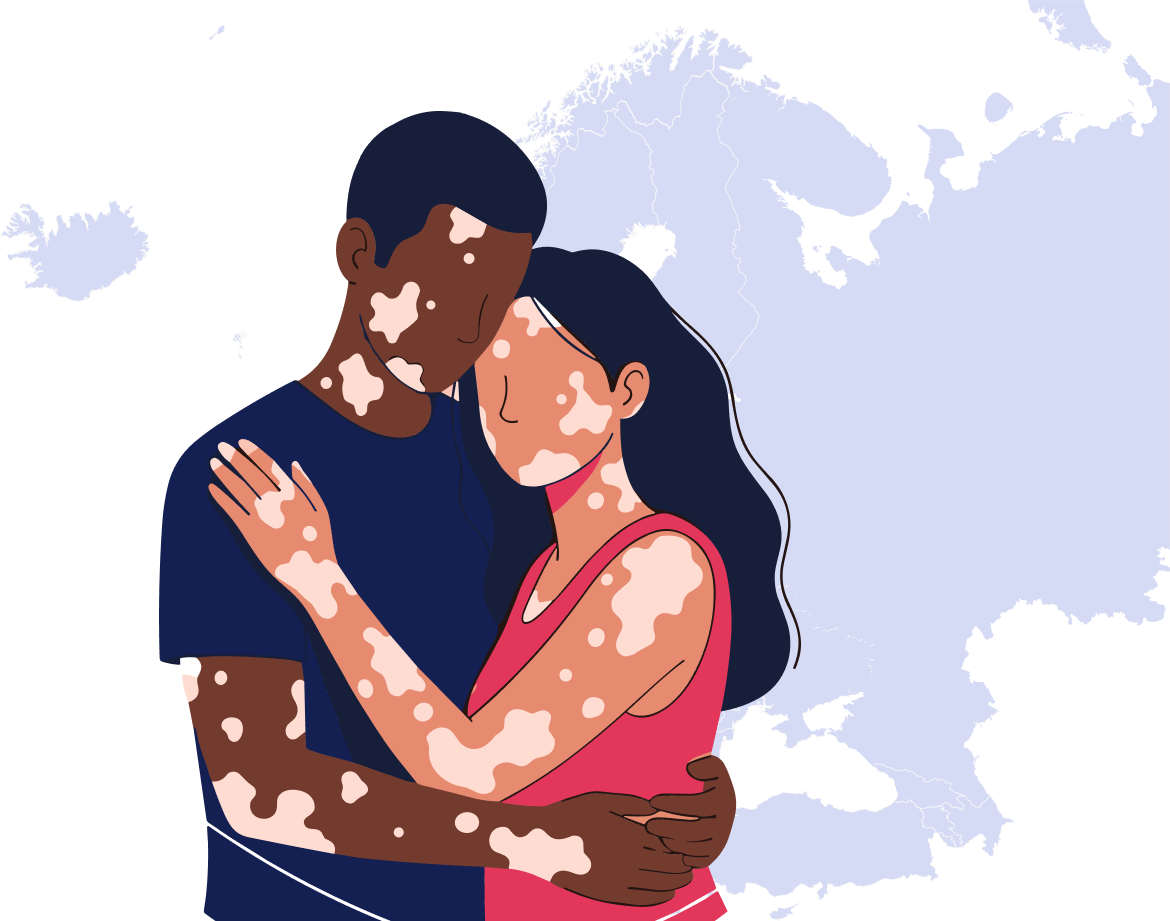
This stigma affects self-esteem and creates a real burden on people with vitiligo. In Europe, 53.9% of people with vitiligo said they often hide their lesions with clothing or camouflage.6 Many others reported avoiding social events, feeling less confident at work or school or delaying seeking care.8 These choices carry costs: in money, time, stress and missed opportunities.
Navigating the stigma: how vitiligo shapes daily choices and routine6
People with vitiligo responding often, very often or all the time to the following outcomes about the impact of vitiligo on their daily lives
Double the healthcare costs and triple the office visits
In the US, people with vitiligo had almost double the yearly healthcare costs of people without vitiligo: US$15,551 vs US$7,735.10,11 In Québec, Canada, people with vitiligo had nearly three times as many outpatient visits as people without vitiligo: 16.1 vs 5.5 visits per year. And their outpatient service costs were almost double.12
Increased healthcare costs10,11
Comparing healthcare costs for people with and without vitiligo in the US
Increased outpatient visits12
Outpatient visits per year for people with and without vitiligo in Canada
Patients incur costs that health systems may not see
In addition to significant treatment and healthcare costs, vitiligo can lead to ongoing out-of-pocket expenses for skin protection and lesion concealment. Each of these individual costs is small, but one study in Italy estimated that they total up to €789 (around US$900) per year on average for each person with moderate to severe vitiligo.13,14
Annual non-drug costs for a person with moderate to severe vitiligo13,14


US$900
in annual non-drug costs

US$170
for concealers/ makeup


US$160
for self-tanners


US$335
for sunscreen
These products help people with vitiligo feel able to go to work, attend school, meet people and take part in public life.

Camouflage comes at a cost
Some people with vitiligo use skin camouflage—specialised, high-coverage make-up—to cover visible lesions and help boost confidence in daily life. But this takes money and time. Skin camouflage involves learning how to apply and remove products safely.15 In the UK, for example, a private camouflage consultation to colour-match the product and learn the application process costs around £50-£80 (US$66-$106), and can take up to one hour.15 But the cost isn't just financial. The daily routine and constant worry of covering up cost time and energy, too.
In a global study of people with vitiligo said…9

“My vitiligo has repercussions on my physical appearance”

“Managing my vitiligo on a daily basis is a burden”

The mental health toll adds to the economic burden
People with vitiligo are more likely to develop recurrent depression and anxiety.16
And those with both vitiligo and mental health conditions have:16

more primary care visits

more recorded time off work

higher recorded unemployment
Vitiligo can affect work, school and daily life
Vitiligo may not physically stop someone from working or studying, but it can still affect daily life.

The social and professional toll of vitiligo6
People with vitiligo responding often, very often or all the time to the following outcomes about the impact of vitiligo on their daily lives
These effects can shape what people wear, where they go, how they work and what opportunities they feel able to pursue.
The impact is not the same for everyone
Vitiligo affects people differently. Factors such as skin tone, visible patches, culture, gender and age can shape the burden. For example, in a global study, people with darker skin tones reported greater effects on their daily life and activities than people with fairer skin. For example, 57.2% of people with darker skin said vitiligo often affected their ability to go to work or school, compared with 40.7% of people with fairer skin. Career choices were often affected for 55.4% of people with darker skin, compared with 36.6% of people with fairer skin.9
Different skin tones, different realities: how skin tone shapes the impact of vitiligo9
People with vitiligo responding often, very often or all the time to the following outcomes about the impact of vitiligo on their daily lives
Consequently, people with darker skin and vitiligo are more likely to develop mental health conditions.16
Society pays too
The impact of vitiligo also carries a social cost.

US$570m
In Italy, researchers estimated the yearly social cost of vitiligo at around €500m (approximately US$570m). People with the condition bore 55% of these costs.13
This means much of the burden falls on individuals and households, not just health systems.
The wider costs can include:

paying for products and travel

missing work or school

lower productivity

lost opportunities in work, education or relationships
Reducing the burden of vitiligo means looking beyond the skin

Better data on prevalence, disease burden and comorbidities
Better support for out-of-pocket and time costs
Routine attention to mental health and quality of life
Support for people facing stigma at school, work or in daily life
Policies that help people stay active in work, school and society
Vitiligo is visible. Its full cost should be visible too.
As of September 2026, Pfizer has no FDA- or EMA- approved treatments for vitiligo.
References
1 Rosmarin D, Lofland JH, Marwaha S et al. Patient burden of nonsegmental Vitiligo: a US real-world survey of dermatologists and their patients. Dermatology and Therapy. 2024;14(6):1531-1546. Available at: https://pubmed.ncbi.nlm.nih.gov/38753072/
2 Eleftheriadou V, Atkar R, Batchelor J et al. British Association of Dermatologists guidelines for the management of people with vitiligo 2021. British Journal of Dermatology. 2022;186(1):18-29. Available at: https://pubmed.ncbi.nlm.nih.gov/34160061/
3 Canadian Dermatology Association. Vitiligo. Canadian Dermatology Association; 2026. Available at: https://dermatology.ca/public-patients/diseases-conditions/skin-conditions/vitiligo/ [Accessed June 2026]
4 Marzano AV, Alberti-Violetti S, Maronese CA et al. Vitiligo: unmet need, management and treatment guidelines. Dermatology Practical and Conceptual. 2023;13(4)S2:e2023316S. Available at: https://pubmed.ncbi.nlm.nih.gov/38241398/
5 Bergqvist C, Ezzedine K. Vitiligo: A Review. Dermatology. 2020;236(6):571-592. Available at: https://pubmed.ncbi.nlm.nih.gov/32155629/
6 Ezzedine K, Harris JE, Hamzavi IH et al. Exploring vitiligo history and mental health burden among people within EU5 countries: findings from the global VALIANT study. Dermatology and Therapy. 2025;15:2439-2453. Available at: https://pubmed.ncbi.nlm.nih.gov/40613847/
7 Al-smadi K, Imran M, Leite-Silva VR, Mohammed Y. Vitiligo: a review of aetiology, pathogenesis, treatment, and psychosocial impact. Cosmetics. 2023;10(3):84. Available at: https://www.mdpi.com/2079-9284/10/3/84
This research has been commissioned and funded by Pfizer. Research was conducted by Economist Enterprise, which retained full editorial control of the programme. While every effort has been taken to verify the accuracy of this information, Economist Enterprise cannot accept any responsibility or liability for reliance by any person on this report or any of the information, opinions or conclusions set out in this report. The findings and views expressed in the report do not necessarily reflect the views of the funder.
Related content
The psychological impact
Vitiligo's psychological and social toll is often under-diagnosed. Explore the mental health data behind this visible, misunderstood condition.

The cosmetic label
Dismissing vitiligo as cosmetic delays diagnosis and treatment. Explore the clinical, financial and psychological costs patients face as a result.
PP-UNP-GLB-3590 | September 2026