

Multiple sclerosis (MS) is a chronic disease that causes the body’s own immune system to attack the protective sheath around the nerves, affecting the brain and spinal cord. Globally, more than 3.1m people are living with MS—and someone is diagnosed with MS somewhere in the world every 5 minutes.1,2 MS disability is often assessed through its effects on physical and motor function, but the condition affects far more than mobility. Fatigue, cognitive impairment, pain, mood changes and sexual dysfunction can shape whether people are able to work, participate in social life or live independently.3 Yet recent research suggests that many of these less visible dimensions of disability are not routinely assessed, creating a gap between what is measured in the clinic and what people experience in everyday life.
Economist Enterprise research, supported by Sanofi, examines this gap alongside the economic burden of MS on people, families and health systems across France, Germany, Italy, Spain, Sweden, the United Kingdom and the United States. The findings reveal that measuring disability more fully is essential to understanding how MS affects people’s working and social lives, families and finances.
What clinicians routinely measure is not the whole story
Fatigue illustrates this visibility gap particularly clearly. Although it is one of the most commonly reported symptoms among people with MS, it is not routinely assessed by many clinicians. A survey of 850 neurologists found a 41-percentage-point gap between the proportion of people reporting fatigue4 and the proportion of neurologists routinely assessing it. The gap was even more stark for sexual dysfunction, at 45 percentage points. Assessment practices also varied considerably between countries. In contrast, clinicians measured walking difficulties and cognitive impairments more often than patients reported experiencing them.
The Expanded Disability Status Scale (EDSS) remains the most widely used measure of MS disability in MS research and clinical practice worldwide.5,6 However, only 51% of neurologists report using it routinely. Patient-reported outcome measures (PROMs) were not universally used either. At the same time, only around half of neurologists assessed broader impacts such as productivity at work, participation in social activities and effects on caregivers.
Comparing patient-reported MS symptoms with clinician assessment
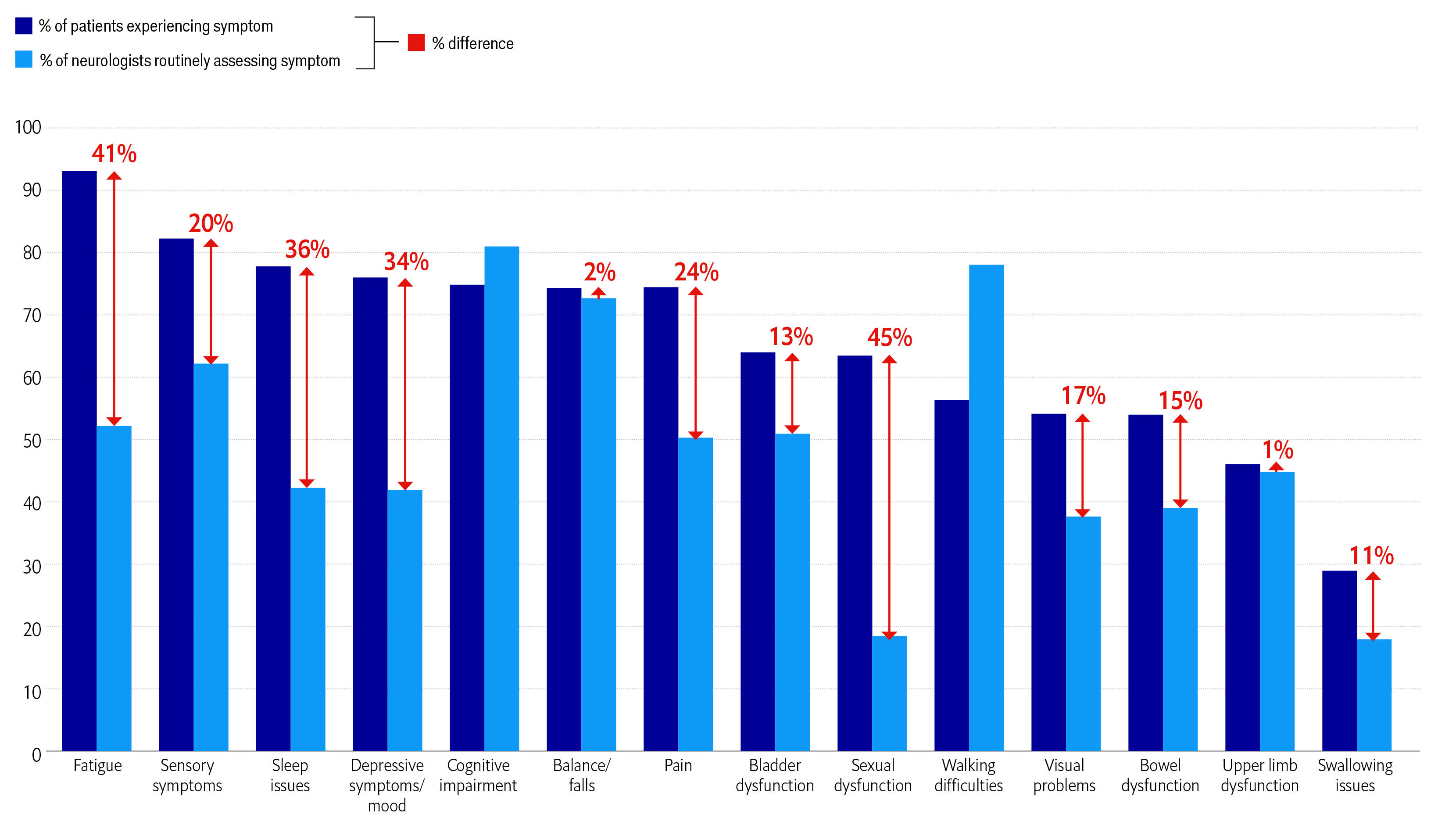
Source: patient survey from European Multiple Sclerosis Platform (EMSP); neurologist survey conducted by Economist Enterprise
The real cost of MS accumulates beyond healthcare
The impact of MS is not just clinical. It is also economic, and it grows as disability becomes more advanced.
Economist Enterprise’s economic modelling shows that people living with MS, their families and health systems face substantial costs in all seven countries studied. Average annual costs per person were estimated to range from approximately US$57,000 in the United Kingdom to US$146,000 in the United States. As the disease advances, lost productivity and unpaid care account for a larger share of the economic effects, alongside expenses for mobility support, home adaptations and other needs outside formal healthcare.
Measuring disability means measuring more of its effects
Although common, non-visible symptoms such as fatigue and cognitive decline directly affect daily functioning, job retention and personal independence, they are frequently overlooked in clinical evaluations. Because MS frequently emerges during working and family-building years, between 18 and 50 years of age7, disability can affect employment, income, relationships, caring responsibilities and social participation over decades.
Although these effects shape the financial impact of MS on people and their families, only about half of surveyed neurologists regularly evaluate someone’s ability to perform their usual work, remain in employment or manage everyday activities. Consequently, the economic ramifications of MS frequently spill over into domains that routine clinical care fails to consistently assess.
Making the full burden visible
Neurologists recognise the limitations of the current system: 72% surveyed said a more comprehensive approach to disability measurement is needed. Around half cited insufficient time during appointments, limited staff and resources, concerns about existing measures and difficulty integrating assessments into clinical practice as practical barriers.
Barriers and Solutions to Comprehensive Disability Measurement reported by neurologists
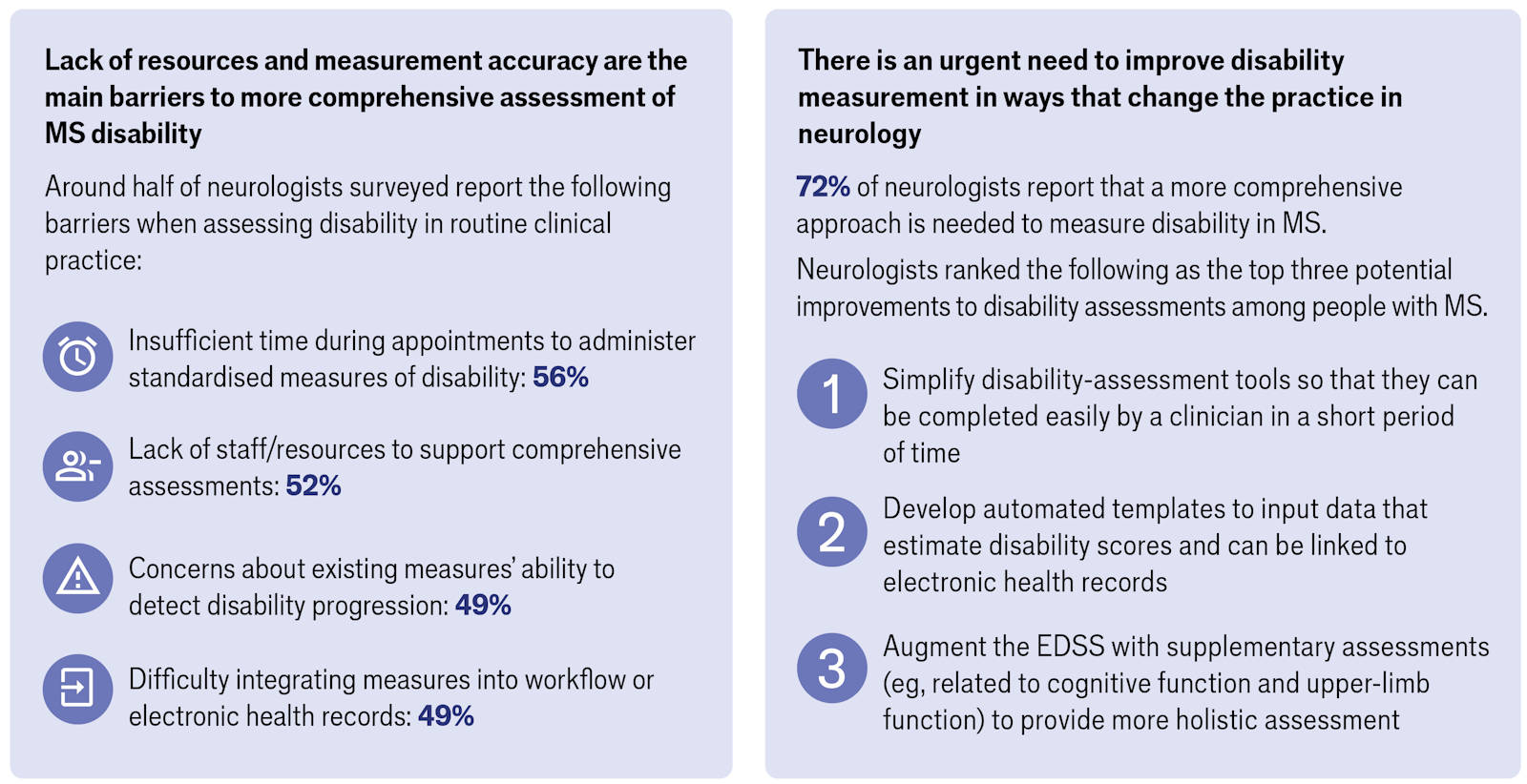
The research points to assessments that are simpler to use, more responsive to individual priorities and better able to capture cognitive, emotional and social impacts alongside physical disability. Digital tools, including wearable sensors and mobile applications, may help when integrated effectively into routine care.
Capturing the full experience of MS could help close the gap between clinical measures and everyday life—and provide a clearer picture of how MS affects people with the condition, their families, health systems and society.
References
- 1.Atlas of MS. MS International Federation. 2025. Available from: https://atlasofms.org/map/global/epidemiology/number-of-people-with-ms#about
- 2.Walton C, King R, Rechtman L, et al. Rising prevalence of multiple sclerosis worldwide: Insights from the Atlas of MS, third edition. Mult Scler. 2020;26(14):1816-21.
- 3.As reported by the Impact of Multiple Sclerosis Symptoms (IMSS) survey of more than 17,000 people with MS, conducted by the European Multiple Sclerosis Platform; EMSP. Impact of Multiple Sclerosis Symptoms (IMSS). European Multiple Sclerosis Platform. 2025. Available from: https://emsp.org/projects/impact-of-multiple-sclerosis-symptoms-imss/
- 4.EMSP. Impact of Multiple Sclerosis Symptoms (IMSS). European Multiple Sclerosis Platform. 2025. Available from : https://emsp.org/projects/impact-of-multiple-sclerosis-symptoms-imss/
- 5.Arteaga-Noriega A, Zapata-Berruecos J, Gutiérrez-Vargas J, et al. Factors associated with the progression of disability (EDSS) among MS patients. eNeurologicalSci. 2026 Mar;42:100602. doi: 10.1016/j.ensci.2025.100602.
- 6.Meyer-Moock S, Feng YS, Maeurer M, et al. Systematic literature review and validity evaluation of the Expanded Disability Status Scale (EDSS) and the Multiple Sclerosis Functional Composite (MSFC) in patients with multiple sclerosis. BMC Neurol. 2014 Mar;14:58. doi: 10.1186/1471-2377-14-58.
- 7.When multiple sclerosis is suspected in patients under 18 or over 50. Cleveland Clinic Consult QD. 2024 Sep 17. [Accessed 2026 Sep 27]: https://consultqd.clevelandclinic.org/when-multiple-sclerosis-is-suspected-in-patients-under-18-or-over-50