

Around lunchtime on April 28th 2025, much of the Iberian peninsula went dark. Trains stopped, traffic lights failed and hospitals suspended routine operations as continental Spain and Portugal suffered a widespread blackout. It was Europe’s most severe power-system incident in more than two decades.
A subsequent investigation found that problems controlling the flow of electricity caused the grid to become unstable, setting off a chain of disconnections.
The episode exposed a broader vulnerability. As Europe electrifies, energy security will rest increasingly on the resilience of the networks that carry power and on the equipment and materials needed to keep them working. Demand is rising as industry electrifies, households adopt electric vehicles and heat pumps, and data centres supporting artificial intelligence multiply. Meeting that demand while cutting reliance on imported fossil fuels requires more domestic low-carbon generation and a grid capable of moving that electricity where it is needed.
Europe has already rapidly expanded low-carbon generation. Between 2022 and 2024 the EU added a record 168GW of solar capacity and 44GW of wind, while renewables supplied 47% of its electricity in 2025. But that pace is losing momentum. EU solar installations fell slightly in 2025, their first annual decline in almost a decade, according to Solar Power Europe. Meanwhile, grid congestion and connection delays are making it harder to bring new generation online. The IEA reckons that congestion cost the EU €4.3bn in 2024.
Europe is having to expand and renew its grid at the same time. After around 15 years of broadly flat electricity demand across advanced economies, growth has resumed just as a significant share of Europe’s lines and cables approaches the end of their typical operating life. Replacement needs are increasingly converging with demand for new capacity, according to the IEA’s September report on modernising grids. The European Commission estimates that around €477bn must be invested in transmission grids by 2040, plus €730bn in distribution networks. Its European Grids Package aims to accelerate investment and permitting while making better use of existing infrastructure.
Crossed wires
Expected renewable additions by 2030 compared with available transmission-grid capacity in 17 reporting EU countries (GW)
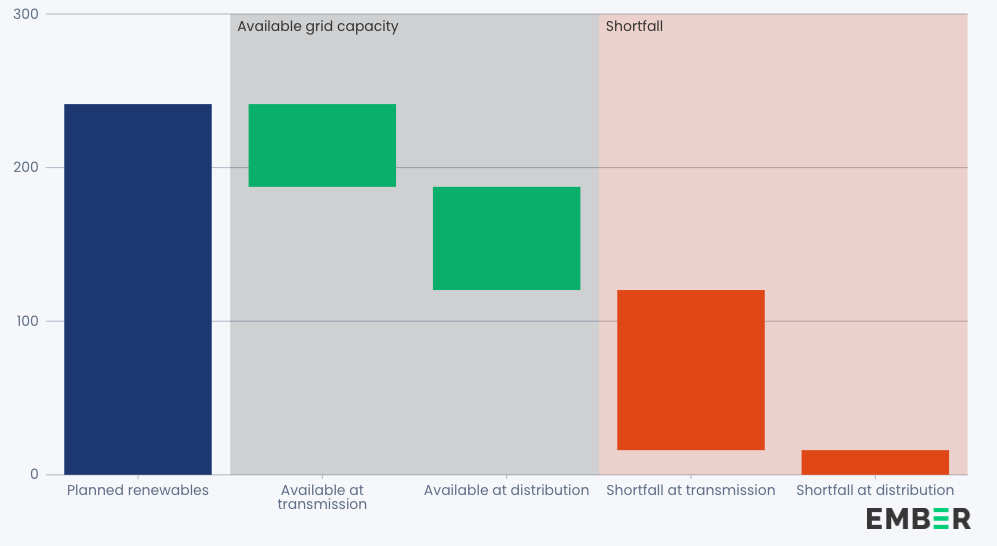
Source: ERAA 2025 for expected renewable additions between 2025 and 2030 See Ember methodology for overview of reporting countries and data sources relating to grid capacities. Reporting countries include: Austria, Belgium, Bulgaria, Cyprus, Czechia, Denmark, Finland, France, Latvia, Lithuania, the Netherlands, Poland, Portugal, Romania, Slovakia, Slovenia and Spain.
Gridlock
But permits and money cannot conjure up cables, transformers and metals, all of which are becoming harder and more expensive to secure. Cables now take two to three years to procure, large power transformers as long as four and some direct-current cables, preferred for long-distance transmission lines, more than five, according to the IEA. Since 2019 cable prices have almost doubled and transformer prices have risen by around 75%.
Materials are a constraint too. Electricity networks need a huge amount of copper and aluminium as well as specialist electrical steel. By 2030 grid construction alone could require copper equivalent to almost 16% of the EU’s current consumption of extracted copper concentrate and nearly 9% of processed copper consumption. The squeeze is on price as well as supply. EIU expects base-metal prices to rise again over the medium term, leaving copper and aluminium well above their 2020 levels through to 2028.
After falling from recent highs, base metal prices will rise in the medium term
Average prices; Q1 2020=100
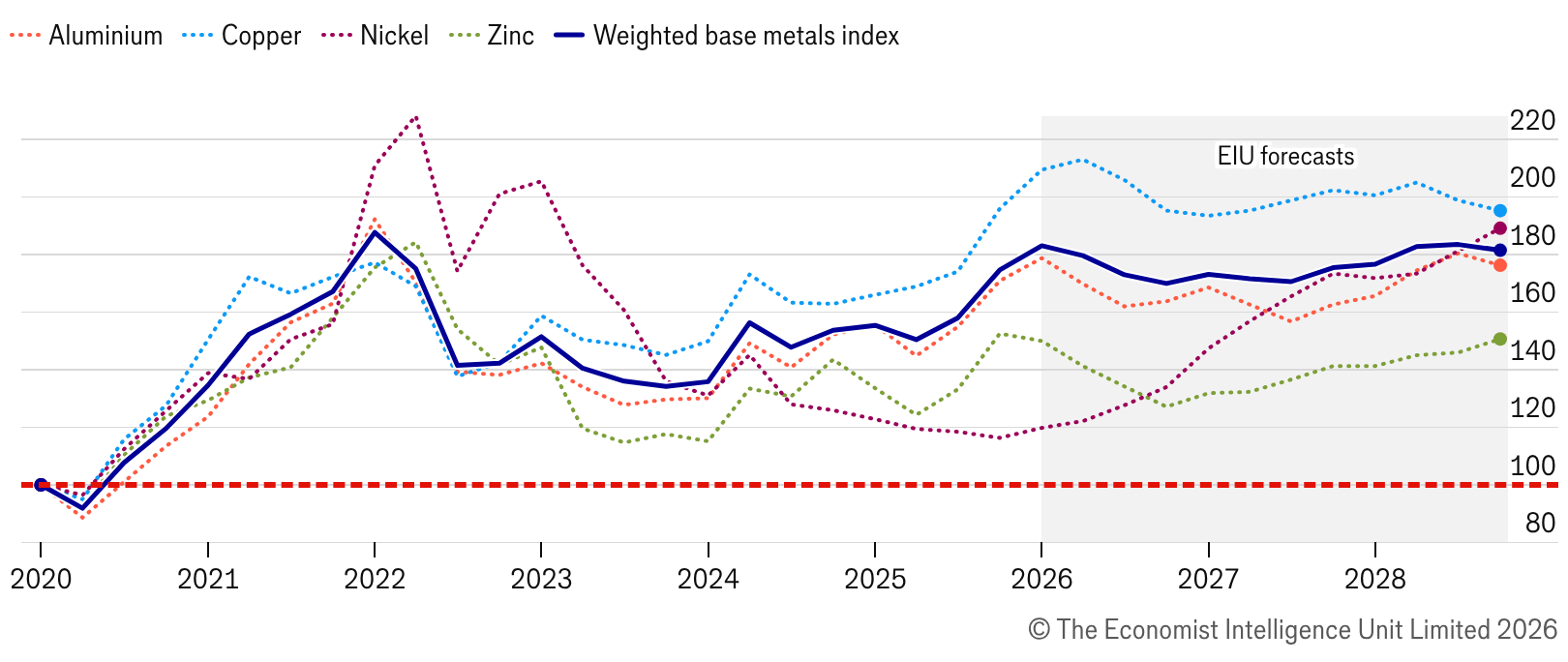
Text in the chart: base-metal prices Weighted base-metals index Sources: World Bank; EIU.
China’s growing use of export restrictions on several critical materials has sharpened Europe’s interests in strategic reserves. RESourceEU’s initiative includes joint purchasing and stockpiling of critical raw minerals, while the EU Stockpiling Strategy considers physical, vendor-held and virtual inventories. The IEA estimates that maintaining reserves for 11 high-risk materials outside dominant supplier countries would cost less than $900m a year. But such stockpiles can only buy time. They cannot substitute for a more diversified supply, recycling and new production.
Finished grid equipment is harder still to stockpile. Large transformers are built to order and rely on specialist steel and skilled engineering, making production difficult to scale quickly. Warehousing enough hardware to insure against every possible shortage would be ruinously expensive. Standardisation could make that reserve more flexible. The EU's Grid Action Plan notes that bespoke specifications limit scale and interoperability—greater alignment could cut costs, increase factory output and make equipment usable across more networks.
A European grid reserve could build on that model through shared inventories, pooled procurement, while holding critical equipment at strategic points across the network. Four Finnish distribution companies have already jointly procured power transformers while retaining separate contracts for their own networks. The Spare Transformer Equipment Programme in the United States requires participating utilities to maintain transformers for emergency sharing.
A second life for grid assets
Countries should look for spare capacity in the network already in service. Grid operators leave operating margins partly because they cannot continuously see how much their equipment can carry under changing conditions. Better digital monitoring and dynamic ratings can reveal some of that unused capacity, while higher-capacity alternatives and other grid-enhancing technologies can increase power flows without building an entirely new route. Many can be deployed in months rather than years, easing bottlenecks while larger grid projects are built.
Europe’s ageing grid also creates an opportunity to modernise as it renews. The IEA argues that refurbishing or replacing an asset is the cheapest time to add sensors, monitoring and controls, rather than retrofitting them later.
Equipment can also be given a second life. Dutch grid operator Alliander has created a circular materials warehouse that allows recovered assets to sit within its normal inventory system. It refurbished 76 compact substations in 2024 and another 34 in 2025 using reused transformers and switchgear. Alongside Enexis, Stedin and Gasunie, it recommends extending asset lives, common purchasing specifications and adapting standards that inhibit reuse.
Refurbishment and repair can also bypass long waits for new equipment and shortages. Hitachi Energy reports that one damaged transformer in Europe was refurbished and returned to service in just over six months, compared with a market lead time of more than 20 months for a replacement. There are limits. Older transformers can have higher network losses, as Alliander discovered, so extending their lives is not always economical or efficient. Large transmission equipment may also be too specialised to move easily between networks. Decisions to reuse therefore depend on condition, compatibility and lifetime costs.
Where whole assets cannot be reused, their materials can be. In 2025 French transmission operator RTE and cablemaker Nexans launched a closed-loop system to recover aluminium from retired high-voltage cables for use in new ones. Around 1,000 tonnes of dismantled cable are expected to yield roughly 600 tonnes of aluminium a year. RTE estimates that recovered aluminium could eventually supply around a quarter of its transmission-grid needs over the next 15 years. The forthcoming Circular Economy Act aims to strengthen the single market for secondary raw materials, potentially making such schemes easier to scale.
Circularity cannot supply a rapidly expanding grid from assets that may remain in service for decades. But a strategic reserve can lie in repair capacity, common specifications and shared inventories; some in assets that can be upgraded or redeployed; and some in the copper, aluminium and steel already running through Europe's grid.