

Technology & Innovation
The next wave of AI is opening doors for everyone
AI is transforming creative ambition. Now, one company aims to make it accessible to everyone.
Every new technology creates opportunities. The personal computer shifted power from centralised mainframes to office desks, enabling the dotcom era. Smartphones put that power into a billion pockets.
Now, AI is driving another technological shift. Generative AI is pushing beyond text and image creation into software development. Powered by large language models that generate code in seconds, these tools are changing how software is built, says David Cai, vice-president at Ant Group.
The company is at the forefront of the “vibe-coding” movement, where people build apps and websites using natural-language prompts rather than traditional coding. Platforms like LingGuang let users build interactive apps without technical expertise or an engineering team.
"LingGuang aspires to be the accelerator of this productivity leap, enabling everyone to create applications of their own," says Mr Cai.
Simplifying complexity
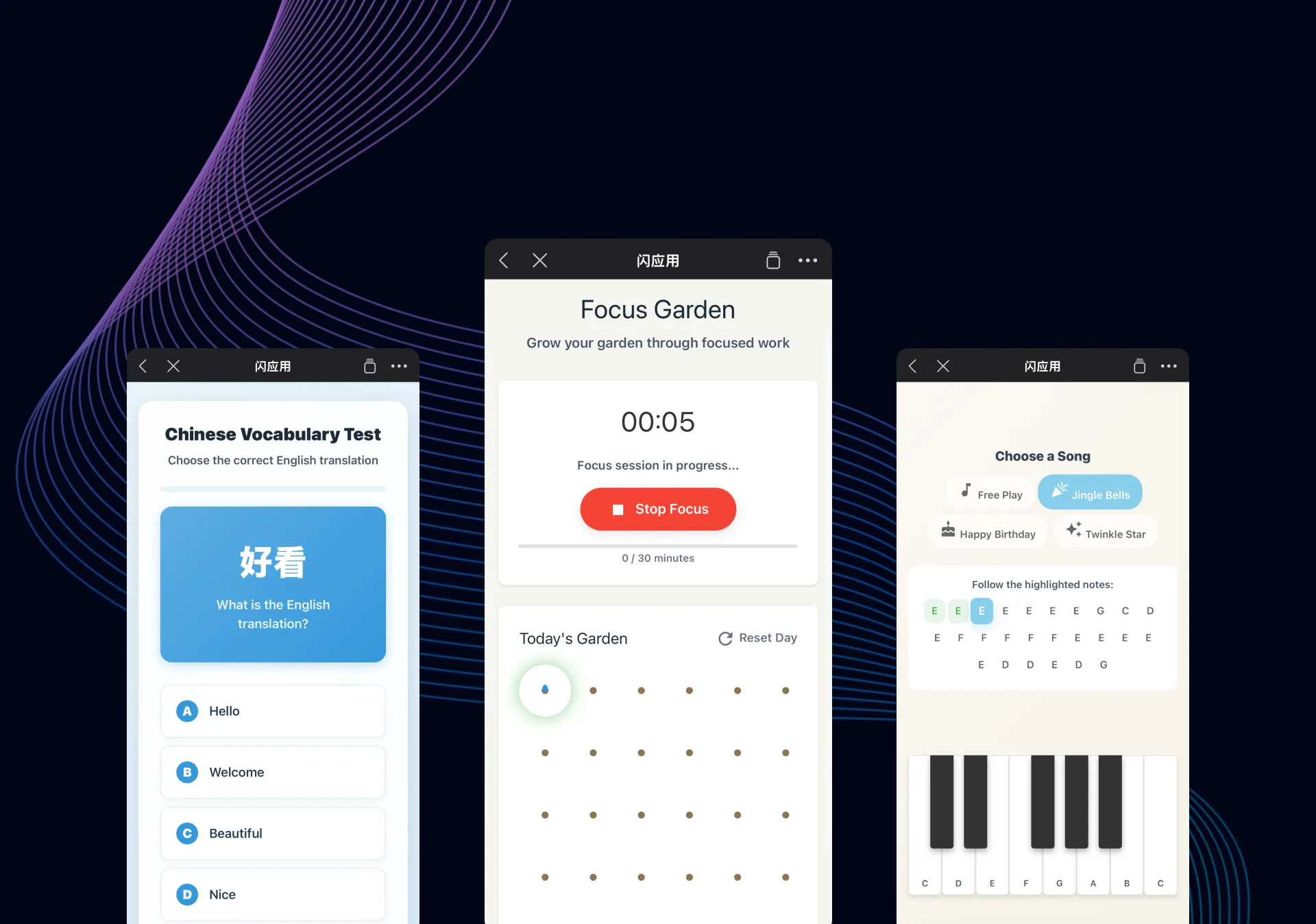
Launched in November 2025, LingGuang is an app designed as a task assistant for users in an era where artificial general intelligence (AGI) will play a prominent role. Powered by coding agents and multimodal interaction, it helps users acquire information efficiently and complete complex tasks.
LingGuang has four core features:
Start of carousel.

LingGuang Flash Apps: a building platform that lets users instantly create, edit and run interactive mini apps with a single prompt.

LingGuang Fast Research: an AI-powered research tool that lets users ask, clarify and refine prompts through natural-language conversation. Rather than returning only plain text, it generates interactive web pages that combine text, images, audio and other media. Users can explore 3D models, interactive maps, data visualisations and audio experiences directly in their browser.

Live Call: a built-in chat feature that allows users to have real-time voice conversations.

AGI Camera: an AI-enabled camera that is multimodal, meaning it can interpret text, images and documents. This helps users analyse or edit content in real time without uploading files.
End of carousel.
As AI develops, LingGuang is also evolving to provide users with more advanced tools that can take on more complex tasks. It starts simple: using the chat to consume information and create AI-generated content. Then, users can perform more complex actions, for example building and publishing apps on LingGuang Circle.
Described by Mr Cai as “the world’s first no-code, app-sharing community”, LingGuang Circle is Ant Group’s marketplace that allows people to use AI to create applications without needing to know how to code. LingGuang’s users have already created over 30m new Flash Apps. And people can then share, discover and monetise these apps via LingGuang Circle’s secure ecosystem.
Inclusive AI
Younger, AI-native users, primarily from China’s biggest and fastest-growing cities, are adopting new technologies quickly, says Mr Cai. And they aren’t just using these tools: they want to build their own digital creations.
Until now, building apps usually required coding skills. But LingGuang aims to change that. With minimal human input, it streamlines software development by taking over much of the technical process: writing code, running tests and deploying fixes. Its AI agents can also suggest improvements, helping users turn their ideas into working applications.
Earlier generative-AI platforms primarily produced text and images. In contrast, LingGuang allows anyone with a mobile phone and an internet connection to build simple digital tools in a matter of minutes. Mr Cai likens this technological advance to the arrival of e-commerce platforms like Alipay in the mid-2010s, when Chinese consumers leapt from cash to mobile payments, bypassing credit cards entirely.
The combination of self-running code and generative-AI capabilities is creating what Mr Cai terms a “brand-new medium”, where consumers rather than corporations create the services and solutions they actually want.
"The ability to code is no longer a privilege of the few,” he says. “People can finally be freed from the constraints of insufficient technical capability. As long as they have the patience and the willingness to refine their ideas, their capabilities can grow tenfold, or even 100-fold."

"The ability to code is no longer a privilege of the few"
– David Cai, vice president, Ant Group
The rise of coding agents
One of the most advanced areas of AI is coding agents: autonomous systems that are able to independently write, test, deploy and debug software in a continuous loop. Some of the industry’s biggest firms are betting heavily on them. Claude Code, Anthropic's AI-coding assistant, is now the company’s most popular product and one of its most lucrative, reportedly generating annualised revenue of $2.5bn by early 2026. Dario Amodei, Anthropic’s CEO, predicts that AI systems could soon perform “most, maybe all” of the work now done by software engineers.
LingGuang is making a similar bet. Its “Wish Coding” tool, which can instantly generate code on demand, lets users create new applications simply by describing an intention or desired outcome. Mr Cai believes that wish coding is the next evolution in the vibe-coding movement; making apps as easy to create and consume as short videos or photo carousels.
While many firms are building coding agents for businesses, LingGuang is targeting consumers instead. Rather than helping companies automate software development, it wants ordinary users to build their own tools and applications. “We aim to enable everybody to have their own coding agent and create applications that truly belong to them,” says Mr Cai. In LingGuang’s vision, AI is not ringfenced but widely accessible, inclusive and beneficial—giving everyone the opportunity to be a creator.
What’s the future of AI?
In the long run, LingGuang believes AI will move beyond predefined workflows to reason independently and deliver outcomes without following fixed processes or standard operating procedures. This could create a future in which AI links digital tools to the physical world, allowing people to test ideas—from urban planning to home designs—in virtual environments before building them in reality.
The vision is ambitious, but many of the underlying technologies already exist to deliver the next step in AI capabilities.
To learn more about Ling Guang, visit: