

Building a gateway between traditional and digital finance
After thirteen years and two strategic rebrands, Gate has outlasted many of its early competitors. Now, it is betting its future on becoming the connective tissue between digital and traditional markets.
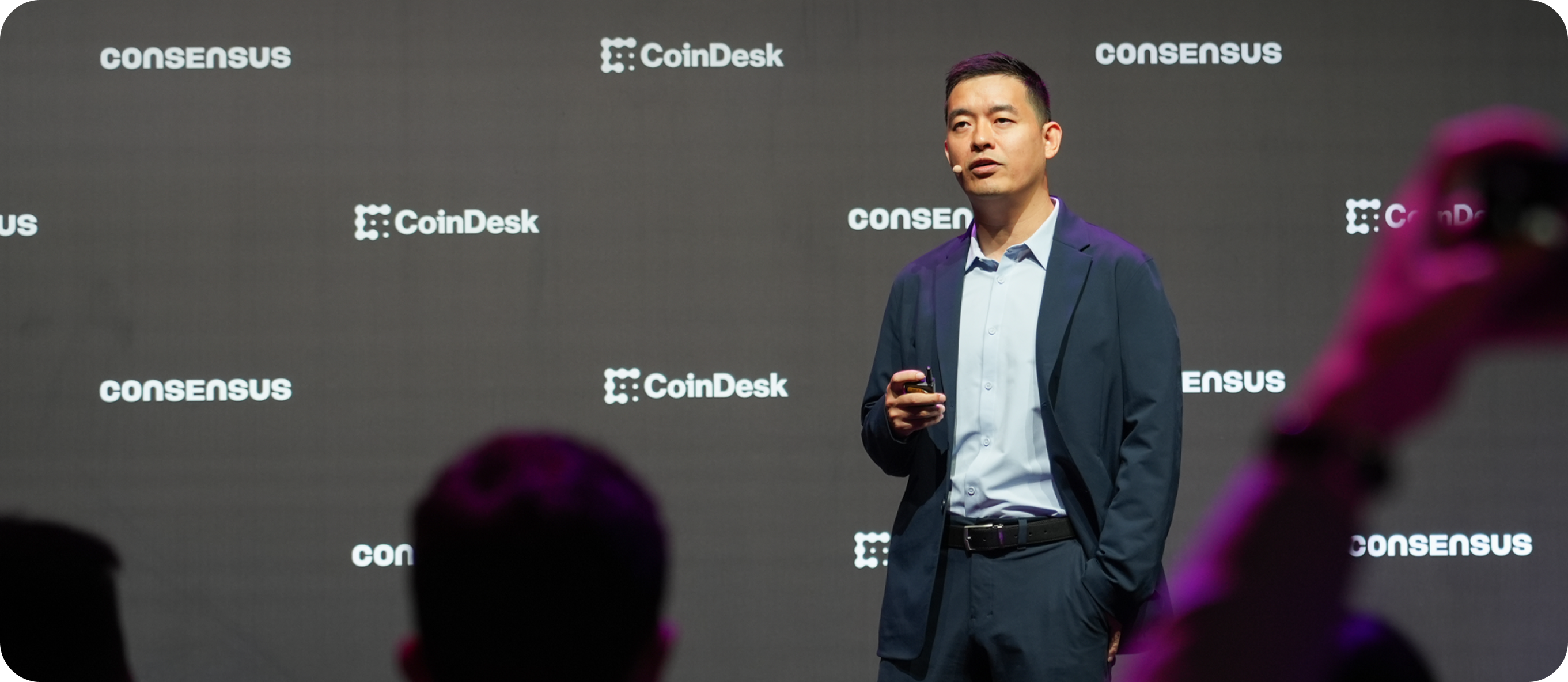
In 2013, Lin Han, then a postdoctoral researcher in optoelectronics living in Canada, lost 100 bitcoin to an online scam. He reported it to the police, who had, by his own account, no idea how to get one back. Frustrated, Han did what engineers tend to do: he built his own fix. He read bitcoin's white paper and its source code line by line, and concluded that if the exchange infrastructure underpinning the then-nascent asset class couldn't be trusted, the answer was to build a better one himself.
That April, Han launched Bter.com, which then underwent a series of rebrands that saw it go from Gate.io to eventually Gate.com. The platform’s iterations have weathered many storms: from China’s 2017 clampdown on domestic crypto trading to multiple market downturns, outlasting a wave of rivals in the process—including Mt. Gox, which collapsed in 2014, and FTX, whose implosion in 2022 rattled the rest of the industry. Today, it is one of the oldest crypto exchanges still standing, and one of the largest, serving more than 58m users worldwide.
"I realised this is not just a technology problem, it's a finance problem," Han says. "It's about risk management, protecting users; it's about the regulation of the industry." Drawing on the lesson those years taught him, Gate.com is pivoting towards its latest goal: becoming the infrastructure connecting retail and institutional capital alike to a blended world of digital and traditional assets.
The convergence play
That shift shows up most clearly in Gate's push to close the gap between crypto and traditional finance (TradFi) products. As real-world-asset tokenisation—putting stocks, metals and commodities onto blockchains—grew exponentially, roughly fourfold from $5.42bn to $19.39bn between January 2025 and March this year, Gate has moved quickly to claim a stake in it: first, through tokenised stocks via xStocks and Ondo; then, through Gate TradFi, a unified account for trading forex, metals and tokenised commodities settled in USDT; next, through pre-IPO access to firms like SpaceX; and most recently, through Gate Stocks, which provides native access to real US, Hong Kong and South Korean equities built with compliant brokers.

Han frames that sequence as a deliberate ladder of increasing regulatory difficulty: synthetic tokens to start, because they are easiest to launch, then derivatives on real assets, then, hardest of all because of the regulatory hurdles involved, direct access to the underlying security itself. "Most of our customers actually know crypto better than they know TradFi assets," he says. For many users outside America, a publicly listed US stock is a less familiar object than bitcoin. Getting them comfortable with equities, he argues, is now more an education problem than a technology one.
To that end, Gate’s research arm has published reports examining the tokenised stock market and looking at the competitive landscape analysis, while its education arm, Gate Learn, recently launched a range of articles and courses on traditional financial asset investing.
As Gate pursues the TradFi integration as a long-term infrastructure play, the harder engineering problem hinges on providing round-the-clock access and liquidity. When American markets close, Gate's customers, many of whom reside outside the US, do not. So, when a stock held through Gate falls sharply while Wall Street sleeps, someone has to absorb that exposure. Gate's answer is a matching engine that leans on limit orders and institutional market-makers to backstop liquidity outside trading hours, a solution Han acknowledges is still being refined and not yet proven at full institutional scale. The gap exists partly because global markets are themselves fragmented across jurisdictions, each with its own rules and trading hours, not because of any unresolved regulatory question.
A gateway for institutional players
In the world of institutional finance, none of this counts for much without the compliance architecture to back it up. That, too, is a key part of the plan. Holding licenses and registrations across a long list of jurisdictions—full EU passporting under both the “Markets in Crypto-Assets” framework and payment institution license via its Malta entity; a distributed-ledger technology license in Gibraltar; registration with Australia's AUSTRAC (the country’s financial-intelligence unit); licenses in Japan and the UAE (the latter via VARA, the authority regulating virtual assets in Dubai); and 35 US state-level money transmitter licenses covering 46 jurisdictions with Gate US—is a competitive advantage institutional players will find value in.
While licenses answer whether Gate is allowed to operate, they don't answer whether it can be trusted with the money. That's what proof-of-reserves is for: a cryptographic audit, built on a Merkle tree, that lets an exchange prove it actually holds enough assets to cover what it owes customers, without anyone having to take its word for it. While Gate didn't invent this kind of transparency, it was one of the first global exchanges to provide third-party audited and open-source proof of reserves in 2020—two years before FTX's implosion forced nearly every other major exchange into the same move overnight.

According to Gate's most recent published report, its reserves currently stand at $9.47bn against a 125% ratio. "I was trying to figure out a way to prove to users that we were honest, that we were managing their funds honestly," Han says. "I believed that this way, not just us but the whole industry could show users real trust."
Han’s pitch to institutions is that Gate has found a way to make compliance possible in a previously largely unregulated area of finance. In many ways, compliance is the product. "Our trading volume is now dominated by institutional clients, not retail," he says, even as retail still generates more revenue per dollar traded. The institutional players moving into digital assets are not the speculative tourists of 2021, he argues, but seasoned survivors of that cycle who "already know what the risk is" and are now returning with lower risk tolerance, greater expertise, and higher infrastructure expectations than the last wave.
Applying AI infrastructure to Web3
Artificial intelligence (AI) is reshaping a lot of industries and Web3 is no exception. Gate has been quick to move, giving AI agents direct access to its trading infrastructure.
Where Gate has acted the fastest, publicly, is on giving AI agents a way into the platform directly. Its GateClaw agent platform, built on the open-source OpenClaw framework, launched with one-click activation, bundles tools for market analysis, product guidance and sentiment tracking, and runs through ordinary messaging apps. Underneath sits Gate MCP, a protocol letting any AI system, not only Gate's own, plug into the exchange's trading and wallet infrastructure, plus a "skills hub" of more than 10,000 installable capabilities.
Earlier this year, Gate launched Gate AI, an overarching model-routing layer letting developers call more than 200 large language models through one API and settle usage in stablecoins, an infrastructure bet on a future in which the customer placing the trade may not be a person at all.
Trust in a ‘trustless’ space
Over a decade ago, a scammed graduate researcher, working alone, concludes that the fix for an untrustworthy exchange is to build a better one from scratch—a solution very much in the spirit of an industry founded on the idea that institutional gatekeepers were not necessary and that trust could be engineered out of finance entirely, replaced by code.
Thirteen years later, Gate's own history reads as much like a rebuttal of that founding premise as a vindication of it. "We've built trust with users, and that's quite important for us," Han says of the years since. From proof-of-reserves, licenses across a dozen jurisdictions, and a compliance function serious enough for institutional money to take seriously, Gate has rebranded with the exact kind of institutional trust his industry was built to make unnecessary.
The founder's instinct that once meant walking away from institutions now means building the infrastructure to let them in. Whether that's Gate abandoning crypto's founding ethos, or simply the industry growing up, is, on the evidence of Gate's own decade, largely a distinction without a difference.