
Rewire your company for AI
Kai-Fu Lee argues most firms adopt AI like factories first used electricity: new power, old workflows. To make it pay, CEOs must own AI, define outcomes, empower owners and build a knowledge moat.

12 Nov 2026
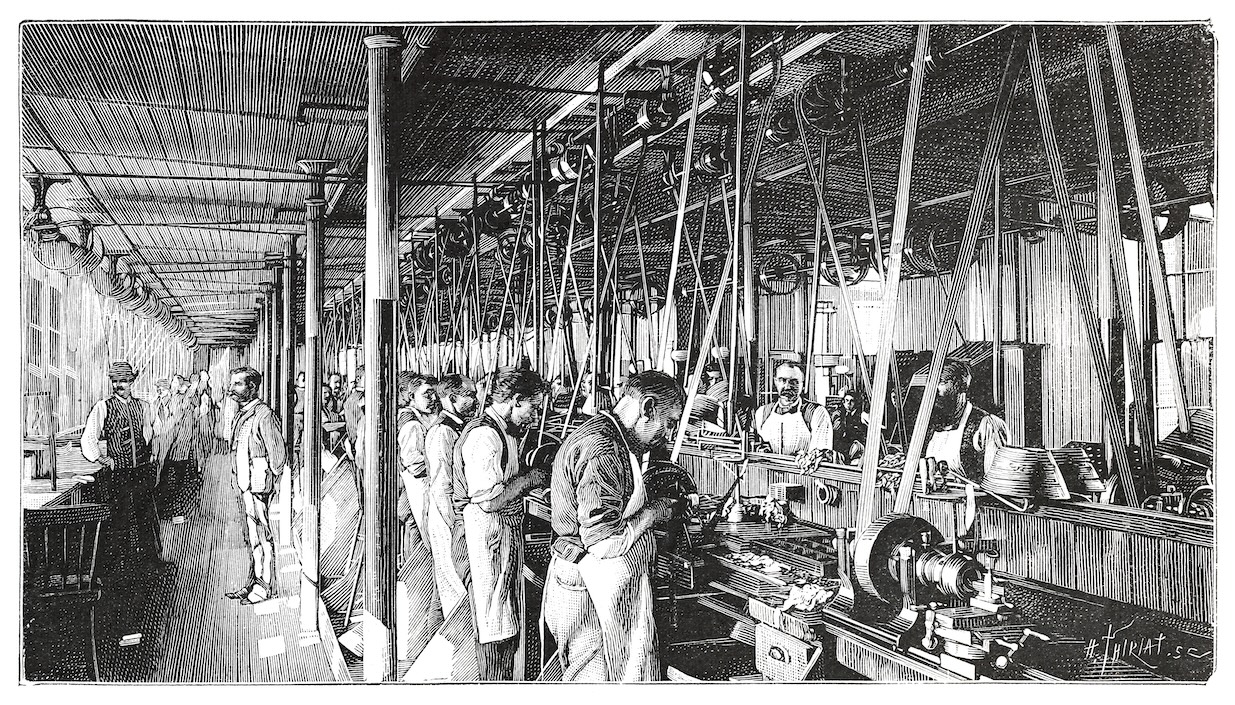
In the 1890s, electric motors began making their way onto factory floors. At first, manufacturers did little more than swap one power source for another. The same system of long drive shafts, belts and pulleys still carried power from the central power source to the factory’s machines, as they always had with steam power. Factories had switched to electricity, yet productivity barely moved.
It took more than forty years for electricity’s transformative power to translate into real gains. That happened in the 1920s, when a new generation of managers gave each machine its own small motor, arranged them around the production process and redesigned the whole factory floor. The breakthrough came not from replacing steam with electricity, but from rewriting how the entire factory operated.
Today, most companies are adopting AI the way factories first adopted electricity.
Over the past year, I have met executives from hundreds of established companies. We talk about AI over coffee at a conference or after a board meeting and one question invariably comes up: “Kai-Fu, we are investing in AI. Are we doing it right?” they ask in a low voice:
For most, the answer is no. The test is simple: nothing has changed in their profit and loss. The data bear this out: for the second year in a row, McKinsey has reported that just 6% of firms say AI is making a meaningful difference to their bottom line, measured as at least 5% of their operating profits. Despite rapid advances in AI and rising corporate investment, meaningful financial returns remain elusive for most companies.
AI not only raises the urgency, but also shrinks the timescale. With the right data foundations in place and AI tools in every employee’s hands, a CEO shouldn’t need more than one year to successfully transform his or her company with AI, even at a large enterprise.
That is not to say that there is a one-size-fits-all AI roadmap. Every business will take a different path, shaped by its unique context and ambition, but certain actions will be critical to progress for everyone – and I would urge leaders to take them now, while there is still time to get ahead.
A chief executive’s first AI task is to understand the technology
The first step costs nothing but is extremely consequential: stop treating AI as yet another IT project and make it a CEO priority. A chief information officer’s job is vital to keep things from breaking, ensuring adoption is secure and ready to scale. But for AI to succeed, it needs to be transformational. That requires vision and authority to challenge the status quo, which only the person at the top owns.
Beware the temptation to delegate understanding along with execution. CEOs need first-hand experience with AI to understand what it can and cannot do, or risk leaving its greatest opportunities on the table.
Define the outcome before buying the tool
Before investing in specific applications, the next priority on the CEO's agenda is to define what business outcomes AI should change. Consider a legal department: it might start adoption with an AI tool that reads contracts faster, saving lawyers a few hours of manual work. But what does that move for the business? A more valuable application might be identifying clauses that expose the company to excessive liability, helping prevent costly payouts, or flagging contractual terms that put deals at risk. One improves efficiency; the other protects profits.
Find the people who rethink the work, and make them owners
Now the challenge becomes to empower others to deliver these results. The CEO cannot and should not run every AI initiative personally; that’s not what owning the AI as a CEO mandate means. Instead, as a CEO, give everyone AI agents and a real business outcome to deliver, and watch what they do. Some will treat AI as a better search engine, many others will simply regurgitate whatever it produces, but a few will rethink how the work gets done almost immediately, delivering results that once required an entire team.
Make these people directly responsible individuals, or DRIs: mini-CEOs who own an outcome and direct a fleet of agents to achieve it. Let them redesign how work gets done. Give them the authority and the rewards that accountability requires.
At my company, 01.AI, each of the four areas we have identified as decisive to our success within the coming six months has a DRI, and those who exceed expectations receive triple the usual stock package. The principle is simple: reward people for owning results, not merely for using AI. For anyone not running a company, becoming a DRI is the best career advice I can offer.
For far-sighted CEOs, the question is what happens next: how do you turn the gains made by a few individuals into a lasting competitive advantage of the organization?
Models can be copied; your knowledge can’t
Models are unlikely to be your moat because anyone can rent and switch them. So focus on what no one can copy – your data and your people’s know-how – and turn your unique experience into an enduring edge. This is the last step, and the one that never ends. Every task an agent completes, and every correction a DRI makes, should add to the enterprise’s collective knowledge base. That knowledge should feed into future decisions and workflows, so the organization gets better with each cycle. The sooner the flywheel starts turning, the stronger your company’s advantage becomes.
When every company can rent the same intelligence, the winners will be those who rewrite companies to put it to work best.
Views or opinions expressed are those of the author and any individuals cited, and do not necessarily reflect those of Economist Enterprise or any other member of The Economist Group.