
The unsustainable logic of health spending
Georgios Margetidis of the European Commission’s Health and Digital Executive Agency explores why healthcare costs continue to climb—and how smarter investment, not just more of it, could reshape the future of care.

12 Dec 2025

As global health systems revert to pre-pandemic spending trends, they remain ill-equipped to meet the growing pressures of ageing populations, technological innovation and rising patient expectations.
The unsustainable character of healthcare expenditure (HCE) is one of the most common truisms in public health as well as, more generally, in public policy.
The covid-19 pandemic distortion has now subsided. In its December 2024 report on the latest health-spending trends,1 the OECD summarised the situation: “The overall health-spending trajectory has returned close to the pre-pandemic trend. This falls short of the estimated additional spending needed to make health systems better prepared for the next crisis and for long-term pressures, such as ageing populations.” In other words, the reversion to trend leaves health systems underfunded to address the multiple driving forces behind increased healthcare needs:
The ageing of the population, with an increasing proportion of people living longer, albeit with one or more chronic diseases.
Citizens’ demand for a more people-centric and personalised approach in the way care is delivered to them.
The continuous and multiple innovations in pharma, medical treatments and technologies.2
This increase in costs affects all countries and all types of health systems—state-funded or health-insurance funded, with or without an important role for private providers, with universal health coverage or not—in developed and developing nations alike.3 However, the specific mechanisms underlying this general trend are, of course, different, reflecting the heterogeneity of countries’ development status and health systems.
In addition, we can question the degree to which additional HCE leads to positive returns, as investing in healthcare is not necessarily a synonym for investing in health.4 By contrast, the evidence shows investing in public health5 to be cost-effective, provide value for money and give returns on investment in both the short and longer term.
Against this backdrop, policymakers have tried many approaches to contain rising costs, whether on the demand or the supply side.
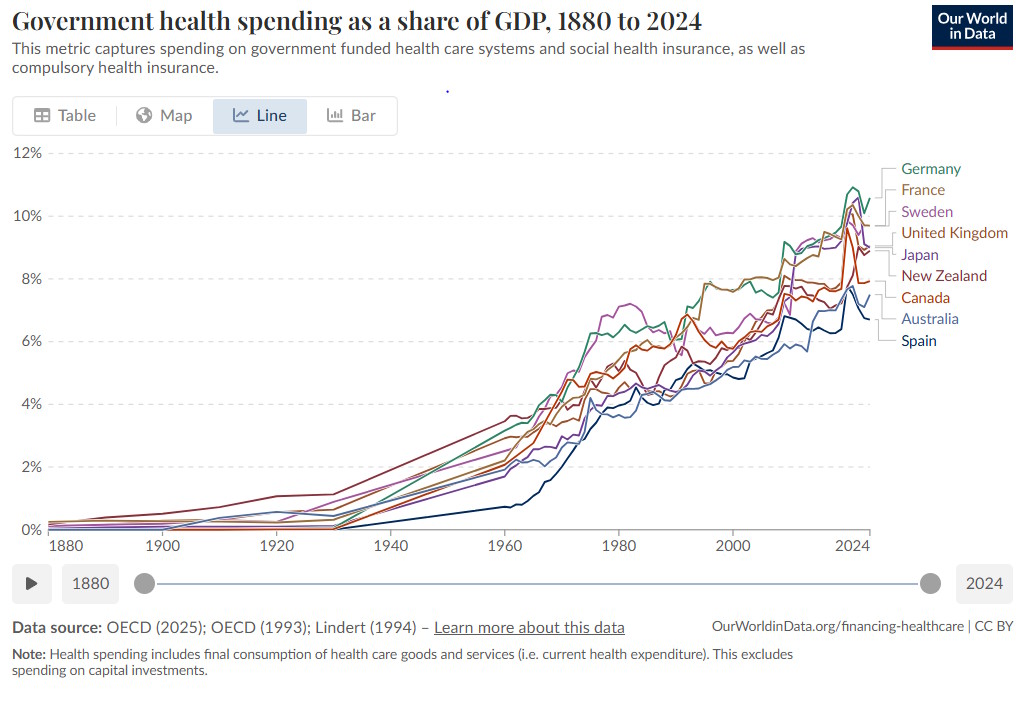
Source: https://ourworldindata.org/grapher/public-health-expenditure-share-gdp Text in the chart: government-funded healthcare systems healthcare goods and services
On the former, policies have tried to increase the level of co-payments; expand health-insurance coverage and access to healthcare services;6 change the financial incentives; and regulate or restrict access to care or treatments. Nevertheless, there are limitations to these measures as they often result in increasing unaffordability for those parts of the general population that most need access to health services.
On the latter, efforts have focused on reducing the number of beds7 or closing entire hospitals; introducing care pathways or case-management models; and breaking down the silos between hospital and community care or between social care and healthcare8 to reduce redundant work and duplication of efforts.
As a result, there are currently a multitude of initiatives across healthcare systems, many of which have shown real promise and, in some cases, concrete results. The situation is certainly not black and white: two recent articles in The Economist highlight the key tension at the heart of the issue.
In his opinion piece, Jake Auchincloss refers to the Baumol effect or cost disease affecting healthcare delivery and costs, and argues for turning custom services into mass-produced goods, while also diverting patients from the most expensive sites of care.9
In one of its latest special reports, The Economist also looks at the significant progress made in the fight against cancer:10 even though this progress is derived from a mostly conventional approach to fighting the disease within a largely unaffected healthcare system, there are also lessons to be learnt here.
A key point concerns the role of innovation: often a new technology or innovation does not displace the previous one but comes as an add-on to the existing care-delivery scheme. And despite progress, healthcare is still delivered today in pretty much the same structures as in the past (inpatient and outpatient care; community/home care, primary-care practices and hospitals).
Important trends, observable across multiple industries and services, namely the increased segmentation between the “commoditised” and the high-margin parts of a given market are not delivering results in terms of reduction of costs. That is also the premise of Jake Auchincloss’s article: production at scale to yield the benefits of standardisation and automation in healthcare-services delivery, including through the use of AI.
In future instalments, we will take a look at some important interventions that have the potential to change the way care is delivered, bringing health-system performance fully into the 21st century.
Views or opinions expressed are those of the author and any individuals cited, and do not necessarily reflect those of Economist Enterprise or any other member of The Economist Group.
References
- 1.
- 2.The Global Healthcare Cost Surge: Challenges and Implications : https://healthmanagement.org/c/hospital/News/the-global-healthcare-cost-surge-challenges-and-implications
- 3.Healthcare Spending - Our World in Data : https://ourworldindata.org/financing-healthcare
- 4.
- 5.The case for investing in public health : https://iris.who.int/bitstream/handle/10665/170471/Case-Investing-Public-Health.pdf
- 6.Expansion of health-insurance coverage and improvements in access to and utilisation of healthcare services
- 7.Hospital beds | OECD : https://www.oecd.org/en/data/indicators/hospital-beds.html
- 8.Health and Social Care Reform in Scotland – What Next? - PMC : https://pmc.ncbi.nlm.nih.gov/articles/PMC8555477
- 9.A congressman on how Democrats can regain the initiative on the economy : https://www.economist.com/by-invitation/2025/07/03/a-congressman-on-how-democrats-can-regain-the-initiative-on-the-economy
- 10.The world is making impressive progress averting cancer : https://www.economist.com/briefing/2025/07/17/the-world-is-making-impressive-progress-averting-cancer