

World Future Energy Summit champions female climate inclusion
Since 2008, the World Future Energy Summit has shone a bright spotlight on female tech entrepreneurship and leadership. With the global climate crisis disproportionately impacting women, their voices and ideas need to be heard more than ever.
5 min read

An imbalanced global threat
At first glance, climate change should represent the “ultimate leveller” – a threat that is entirely dispassionate and non-discriminatory in how it ravages the health and livelihoods of humans across the world. However, even the most cursory of investigations reveals that the risks and burdens of climate change are not being borne equally. We may all share the same global atmosphere and interconnected ecosystems, but we are not all equally in harm’s way.
Climate change consistently impacts females more significantly than males. In many parts of the world, women have fewer access routes to financial resources and land ownership, limiting their ability to recover from disasters such as drought or flooding. During such crises, girls and young women are more likely than their male counterparts to be pulled out of school to help at home. Climate change can also affect women’s health more severely, as rising temperatures are associated with pregnancy complications, pre-natal stress, menopausal issues and other adverse impacts.
Despite their more restricted financial options, more limited educational opportunities and more severe health risks, the UN reports that females remain under-represented in climate policy and disaster response planning. This often leads to their needs being overlooked, “baking in” their vulnerabilities and deepening the cycle of disadvantage.
Although the mobilisation of more resources, deployed in a transparently just manner, is essential to tackle the effects of climate change and the main issues at their source, representation is a vital pillar in the ongoing global climate response. Greater female inclusion is a precursor to more equitable decision-making and the faster development of more climate-resilient communities.

Although the mobilisation of more resources, deployed in a transparently just manner, is essential to tackle the effects of climate change and the main issues at their source, representation is a vital pillar in the ongoing global climate response. Greater female inclusion is a precursor to more equitable decision-making and the faster development of more climate-resilient communities.
Building a platform for change
The World Future Energy Summit has a long and proud history of female inclusion and empowerment regarding climate change. Successive summits have striven to provide a line-up of speakers and panellists whose unique experiences and insights represent all societal demographics. Female politicians, C-suite business leaders, academic experts, pioneering innovators, youth activists – their contribution to the strategic response to climate change has only grown more significant with time. At the 2025 summit, almost 40% of the speakers were female.

Headline speakers at World Future Energy Summit 2025
Alya Al Mazrouei, director, UAE Research Programme for Rain Enhancement
Alida Saleh, head of sustainability, JLL MEA
Alicia Eastman, managing director, APC Investors
Alicia Dauth, senior associate environmental consultant – water, AESG
Dina Ibrahim Almannaee, principal project manager, Ministry of Energy & Infrastructure, UAE
The 2025 World Future Energy Summit’s technological innovation-based events championed female innovation and thought leadership more than ever before. The Climate Innovation Exchange (CLIX), and its new sister event that focuses on AI (CLIXai), featured startups that were female-focused, female-founded or female-operated.
This is a deliberate choice in support of the summit’s broader theme of addressing the ongoing gender disparity that remains apparent in the climate conversation globally. Female voices and concerns, and their novel solutions to our shared climate challenges, are not being given the consideration they deserve. This must change.
By throwing the spotlight on female innovations being developed by teams around the world, CLIX and CLIXai aim to underline the risks of under-representation. Only by harnessing the collective power of all human effort and ingenuity can we even hope to create an effective climate response in time to stave off the very worst disaster scenarios envisaged by leading global forums.
By throwing the spotlight on female innovations being developed by teams around the world, CLIX and CLIXai aim to underline the risks of under-representation.
CLIX & CLIXai Innovations in the spotlight
Company: Seabex
Representative: Amira Cheniour, co-founder & general manager
Summary: Agri-tech company revolutionising irrigation management through AI-powered, sensorless platforms.
Company: Aquaai
Representative at CLIX: Liane Thompson, CEO
Summary: Fishlike platform mimics behaviour of real fish to monitor and assess aquatic ecosystems.
Company: NÜWIEL
Representative: Natalia Tomiyama, CEO
Summary: NÜWIEL eTrailer is the first bicycle trailer with electric drive and zero-force sensor technology.
Representation leads to mobilisation
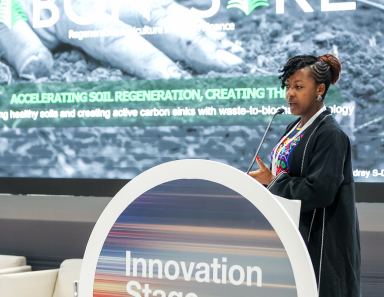

Design, decision-making, implementation – female involvement remains lacking at key steps of both the broader global response to climate change and the specific actions being taken at the national, industry and company levels. By redressing this imbalance, female inclusion will continue to open invaluable new avenues for climate policy, clean tech deployment and more sustainable corporate attitudes overall.
The World Future Energy Summit upholds the principle that every human has a stake and a say in the development of our shared global economy, our shared energy future and our shared climate. Full mobilisation of those unheard voices begins with representation, without which even the most brilliant solutions are denied the opportunity to shine.
