

According to NASA research, 2024 was the warmest year on record. With climate change showing no sign of abating, the energy transition is more important than ever. Although some suggest that net-zero goals are at odds with economic expansion, others are showing that sustainability and growth can go hand in hand.
That is especially the case in the Middle East, where climate change is already having a significant impact. Rising temperatures and more frequent sandstorms have become a reality, and many governments are enacting sustainable policies.
The United Arab Emirates (UAE) is the fastest-growing economy in the region. It is also leading the region’s energy transition, with Dubai particularly active in the drive to attain net zero. The emirate has ambitious plans to become a global leader in tourism and innovation. Sustainability is a strategic priority in its growth plans, which will ensure its long-term prosperity and resilience.
Guided by the vision of His Highness Sheikh Mohammed bin Rashid Al Maktoum, vice-president and prime minister of the UAE and ruler of Dubai, the emirate has published multiple sustainability strategies that target 100% clean energy production by 2050. These include the Dubai Clean Energy Strategy 2050, and the Dubai Net Zero Carbon Emissions Strategy 2050.
The Dubai Electricity and Water Authority (DEWA) plays an important role in the delivery of these strategic objectives. His Excellency Saeed Mohammed Al Tayer, managing director and CEO of DEWA, points out that the organisation helps to ensure that Dubai’s economic development is sustainable. “Dubai is committed to meeting international targets – such as the Paris agreement and the historic UAE Consensus reached at COP28 – by reducing its carbon footprint to limit temperature increases.”

As Mr Al Tayer explains, sustainability is central for Dubai to retain its appeal as a global tourist destination. “Initiatives like green buildings, renewable energy projects and sustainable infrastructure not only improve quality of life, but also attract environmentally conscious travellers and businesses.” This is particularly important, given Dubai’s rapid population growth and its consequent increase in demand for energy and water.
Exploring DEWA’s solar system
Mr Al Tayer points to one of DEWA’s flagship projects, the Mohammed bin Rashid Al Maktoum Solar Park, as an example of how DEWA’s sustainable approach to infrastructure planning supports the emirate’s long-term growth. “It is the largest single-site solar park in the world, with a planned capacity of 7,260 MW by 2030. It will raise the share of renewables in DEWA’s energy mix to 34%, significantly exceeding the initial target of 25%.”
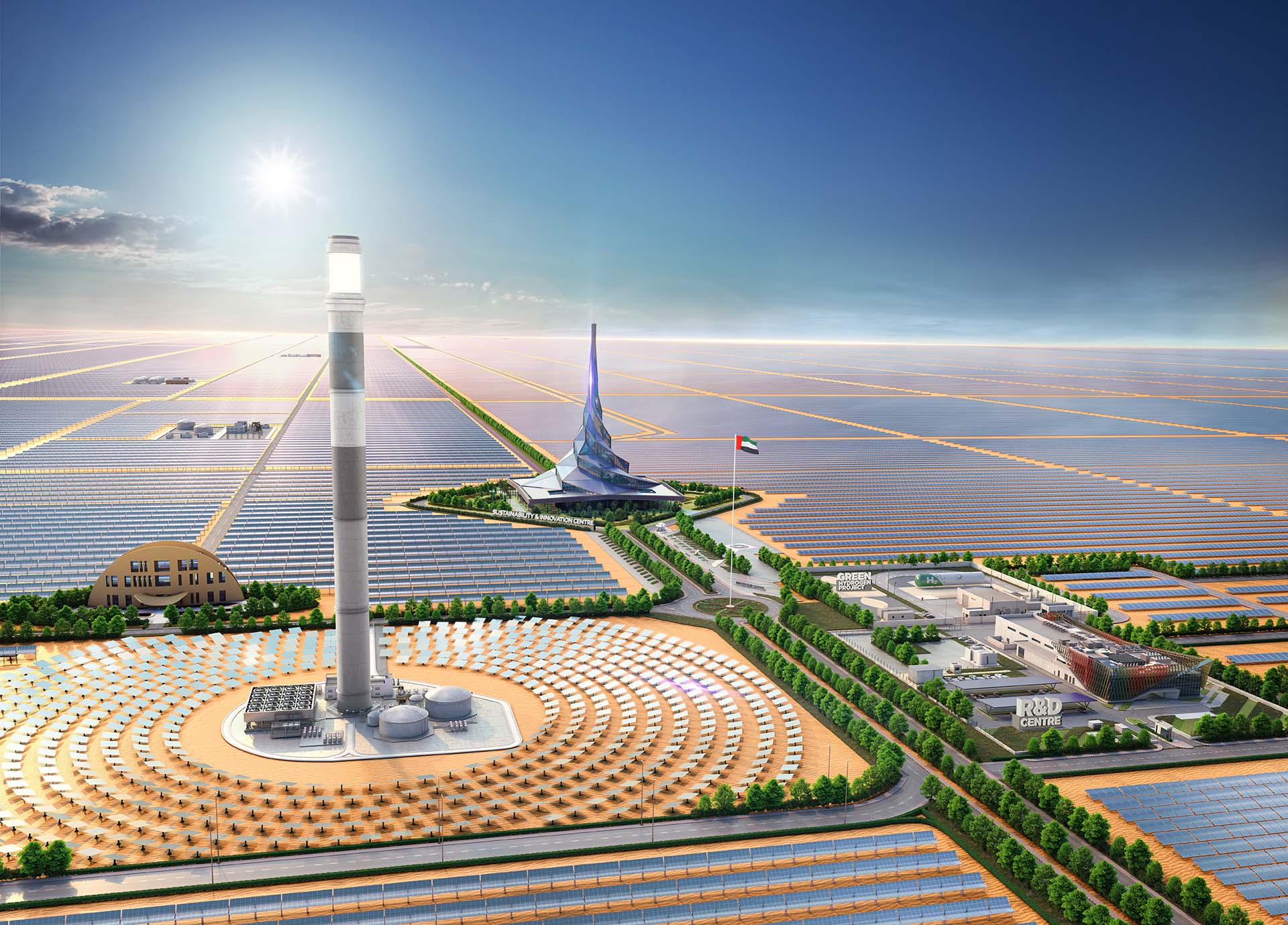
The solar park’s scale and record-breaking achievements are a source of particular pride for DEWA. At just over 263 metres, its concentrated solar power tower is the tallest in the world. The site also includes the largest thermal energy storage site, with a capacity of 5,907 MWh. Its sixth development phase, which is due for completion in 2026, will add a further 1,800 MW of capacity and achieve the world’s lowest levelised cost of energy of US$1.6215 per kWh. The seventh phase will have a capacity of 1,600 MW, expandable to 2,000 MW, utilising photovoltaic solar panels and an advanced battery energy storage system (BESS) with a 1,000-MW capacity for six hours, providing total storage of 6,000 MWh.
By siting several projects side by side, DEWA has developed an ecosystem that fosters innovation and collaboration, based on shared resources and green infrastructure.
A home for bright ideas
In line with Dubai’s strategy to be a global leader in innovation, the park has incorporated several new technologies. “We deployed a diverse mix of technologies that include molten salt and particle-based thermal energy storage, advanced perovskite solar cells, AI-powered drone inspections and autonomous cleaning robots,” explains Mr Al Tayer.
The park acts as a sustainability innovation hub, where DEWA has also located several large-scale projects. Alongside the massive solar generation sits green hydrogen production, DEWA’s Sustainability and Innovation Centre, its Research and Development Centre and its Space-D programme. By siting several projects side by side, DEWA has developed an ecosystem that fosters innovation and collaboration, based on shared resources and green infrastructure.
The green hydrogen project is a cornerstone of the UAE’s emerging green hydrogen industry. The project is the first in the Middle East and North Africa to produce hydrogen through electrolysis powered by solar energy. “Green hydrogen is vital to net-zero goals, providing an efficient medium for storing excess energy that overcomes solar energy intermittency,” says Mr Al Tayer. “It is also critical to the decarbonisation of hard-to-abate sectors, such as transport and heavy industry. The UAE’s goal is to supply 25% of the low-carbon hydrogen market, which is expected to reach more than US$400bn.”
Green hydrogen and battery storage are just part of DEWA’s strategy to manage solar power’s intermittency. It is also using other technologies, such as its 250-MW pumped-storage hydroelectric power plant in Hatta, another first-of-its-kind project in the region.
The green hydrogen project relies heavily on collaboration with DEWA’s R&D Centre to accelerate the development of its technology. Mr Al Tayer describes the centre as a research hub for solar power, smart grids, energy efficiency and capacity building. “Its mission is to enrich scientific knowledge in Dubai, the UAE, and beyond, and it has published 294 research papers and filed 47 patent applications.”

Alongside the R&D Centre is DEWA’s Sustainability and Innovation Centre, a world-leading innovation incubator for the energy and water sectors. This promotes the latest clean energy innovations (including energy storage systems, artificial intelligence and blockchain), develops the skills of the next generation of innovators, and collaborates with local and international organisations on research and exhibitions.
The centre exemplifies DEWA’s commitment to applying the latest innovations to reshape the energy landscape. “DEWA will work to ensure clean energy sources account for 100% of the emirate’s energy production capacity by 2050, and that its infrastructure can support long-term growth without depleting natural reserves,” says Mr Al Tayer. “With these ambitious initiatives to decarbonise, diversify and grow the economy, Dubai is well positioned to achieve our sustainability goals and serve as a model for cities worldwide.”
More from this series

Laying tomorrow’s foundations
The UAE is building a knowledge economy capable of tackling humanity’s greatest environmental challenges

