
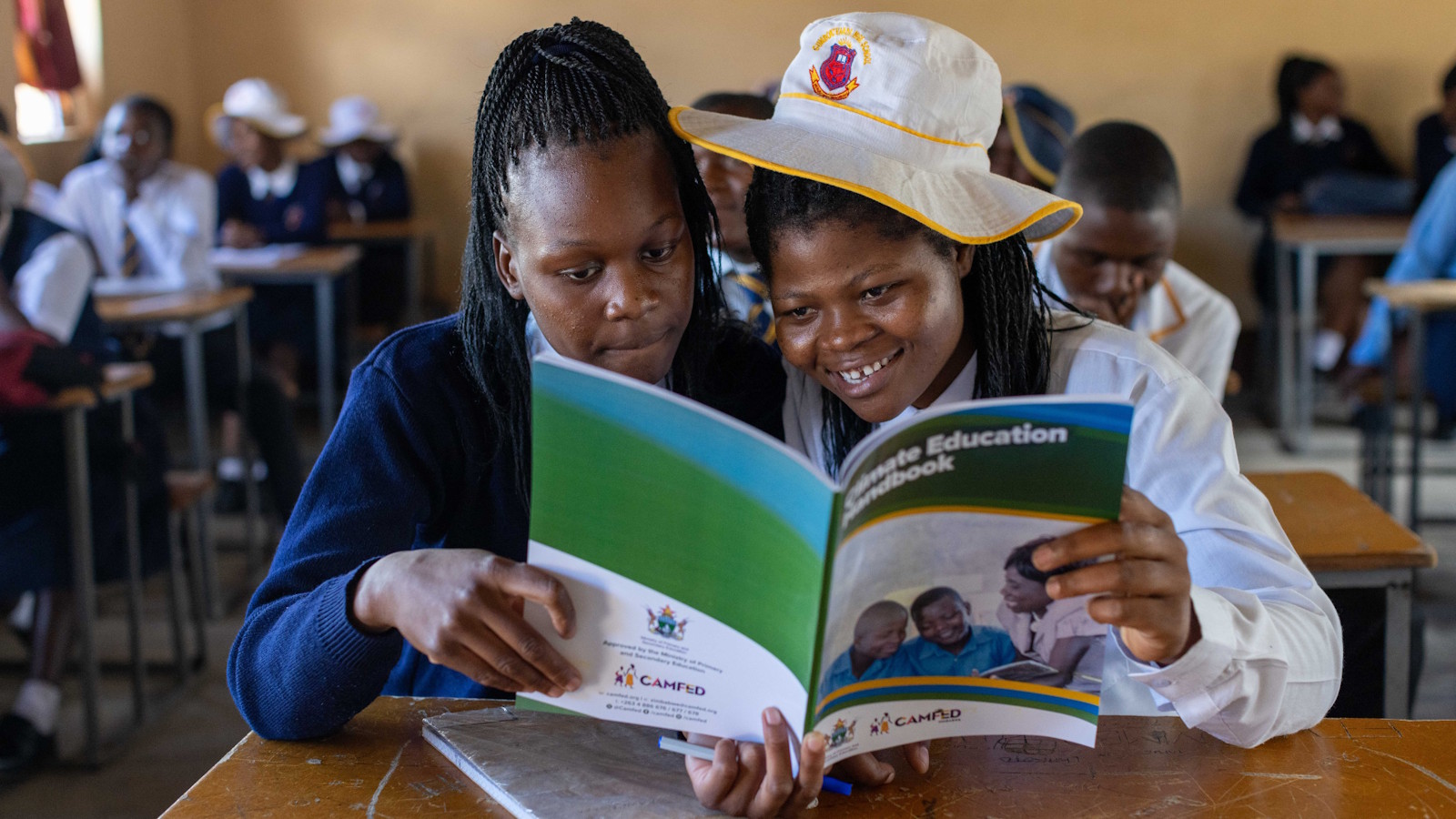
Esnath Divasoni works on the front line of climate education, in a role that not only helps rural communities build resilience but keeps girls in school. From Zimbabwe, where she works as a sustainable-agriculture expert, Ms Divasoni talks about the ways in which these themes—girls’ education and climate education—are twin requirements in adapting to a future under climate change.
“Our communities are hit by all extremes when it comes to climate-related challenges,” she explains. “There is drought, which reduces the amount of food that is harvested, while increasing the distance we must walk to get safe water—a task that typically falls to girls. At the other extreme, we also experience flooding, often in the cyclone season. The harvest might look promising, but then a flood comes and the cassava rot, properties are destroyed and school roofs are blown off. And when hunger strikes, we know that girls’ education becomes less of a priority.”
Ms Divasoni works with the Campaign for Female Education (CAMFED), an organisation that won a UN Global Climate Action Award at COP25 and one that supported Ms Divasoni’s own education when a cyclone wiped out her father’s farmland. Having returned herself to work with CAMFED, she says this is a common outcome of the hands-on, action-driven approach they take to climate literacy: “The girls we teach and support often return as volunteers, as agriculture guides, to mentor and educate the next generation in climate-smart agriculture. They act as a conduit for literacy, spreading knowledge through their families and their communities.”
The numbers speak to the success of this approach: “We have reached more than 150,000 community members across Africa, as well as 49,000 children in classrooms across Zimbabwe and Zambia. And our surveys found that, a month after attending these in-school climate-education sessions, around 76% of the children shared that information in the wider community, with their families, with younger students who are not yet receiving these classes or with recent graduates who missed out,” explains Ms Divasoni. “Around 92% said they felt positive about the role they can play in responding to the challenges of climate change,” she adds.

Esnath — a member of the CAMFED Association of women leaders educated with CAMFED support — conducts a climate change education session for secondary students. Credit: CAMFED/Tafadzwa Ufumeli Date: March 2024 Location: Wedza, Zimbabwe
This positivity cannot be understated. A global study of 10,000 children and young people, published in 2021, found that almost 60% were very or extremely worried about climate change, with the authors pointing to the fact that “climate change has important implications for the health and futures of children and young people, yet they have little power to limit its harm.” Today, there is a growing focus on the role of agency in climate literacy, not just on the ground but at the policy level too.
Building global integration
Helping shape policy and push themes of agency at the global, national and local level are bodies like the United Nations, where Julia Heiss, a social anthropologist and UNESCO’s chief of section for education for sustainable development (ESD), says there has been an evolution in thinking around education in recent years. “For a long time, we were seeing a focus very much on access to education and equality—making sure that all girls and boys have a chance to get foundational skills. That effort remains, but the question is evolving. We are now asking ‘education for what?’ We need to think about the big challenges that young people, educated today, will need to address in a couple of years.
“We need to be looking into post-carbon societies, climate justice, climate action,” she continues, stressing the challenge that this poses. “It means teaching across subject areas, scaffolding according to age, being careful that you’re not just dooming and glooming, but motivating action and critical thinking.”
UNESCO launched its ESD for 2030 programme in 2020, guided by a framework built around five pillars: policy, learning environments, educators, youth and communities. A year later, countries committed to urgent action to implement ESD through the Berlin Declaration on Education for Sustainable Development, and in 2022 the UN held a three-day Transforming Education Summit in New York.
The goal, says Ms Heiss, was to urgently address evolving education needs, while bringing together key actors from climate change and education into a single platform. One of the outcomes from that summit is the Greening Education Partnership[1] , with nearly 100 countries and around 1,900 partners, which aims to integrate climate literacy into teacher education, school infrastructure and curriculums around the world. Among the goals in place is to have climate education integrated into 90% of national curricular frameworks by 2030. When launched, UNESCO research found that nearly half of the 100 countries reviewed had no mention of climate change in their national curriculum.
| Number of studies focusing on mitigation, adaptation, both or neither | |
|---|---|
| Mitigation | 62% |
| Adaptation | 3% |
| Both | 27% |
| Neither* | 7% |
*Interventions deemed too theoretical (eg, description of the physical processess of greenhouse mechanisms) to be linked to either mitigation or adaptation Source: https://www.afd.fr/sites/default/files/2023-11-04-40-18/Worldwide-effects-of-climate-change-education.pdf
From activism to oranges
It is one thing to look at climate education and policy across hundreds of countries, but what does all this look like on the ground? Ms Heiss points to how different the implementation of climate education can be from one region to another, and one country to another. In France for example, she notes it might take the form of student activism, given that most buildings will be reasonably sustainable and recycling is taken care of by the municipality. “The focus is much more on making sustainable lifestyle choices.”
Interestingly, she contrasts this with an example from Zimbabwe, where she has recently been working at UNESCO’s Southern Africa office. There, alongside the work that Ms Divasoni and CAMFED are doing, is another UN award-winning example of sustainable education. Sihlengeni Primary School, in the arid Matabeleland South Province, won the $50,000 UNESCO-Japan Education for Sustainable Development Prize in 2017 for a permaculture project that began in 1995 and now includes the teachers, students and wider community in cultivating everything from oranges and maize to keeping pigs and chickens.
Such successes are huge wins for communities but even standout examples like Sihlengeni grow from necessity—in this case the realisation that students were coming to school hungry. Ms Heiss points out that “when you talk about the global south, the conversation is much more about adapting to climate change, about foundational changes to their farming practices. These are changes that are being imposed on them by the impact of climate change.”

Members of the CAMFED Association of women leaders educated with CAMFED support standing in their vegetable garden in Mbire district, Zimbabwe. Credit: CAMFED/Cynthia R Matonhodze Date: September 2021 Location: Mbire, Zimbabwe
Lived realities
This theme of choice versus imposition comes out in research too. Dr Nick Simpson, chief research officer in climate-change literacy and complex climate-change risk in the African Climate and Development Initiative at the University of Cape Town, also points to a global divide in climate approaches—though he stresses the impact is not confined to the global south.
“There is also a long history around climate change that is very locked into North American and European public-opinion surveys and research agendas that have focused more on carbon and physical climate-science literacy: what is global warming and how is it caused?” he explains.“That is quite far away from the lived realities of decision making at a company or household level across the majority world.”
He emphasises that this isn’t a “global south” issue, pointing to heatwaves, drought and floods in Spain and other European countries as examples of how lives are already being interrupted by climate change, with long-term consequences that go right down to the detail of life: “Heat affects cognitive ability during exam conditions—it’s going to affect the lifetime earning capacity of our children if we don’t put in good adaptations and urgently,” he says.
Dr Simpson talks about how the bulk of research around climate literacy has been focused on the classroom–when it should be introduced and how much should be taught to different age groups—but for him, this is more about doing the groundwork for a lifetime of awareness and agency, making way for climate adaptations to be integrated into everything from finance to infrastructure, from family or language to heritage and work. “Where climate change intersects with those things that I value, all of a sudden climate change becomes very important to me.”
In this way, Dr Simpson describes climate literacy as “the fertile soil for functional, active responses”, adding that the ways in which information is delivered must be carefully considered. “Agency is a very important dimension that is not well understood at the moment. What we have is an inkling that climate literacy, when it is in the context of fear, can be very paralysing. At the same time, when knowledge of climate change is not well scaffolded together with the right emotional or information safeguards, it can be very abstract, which also leads to inaction.” He says a middle ground—of emotional investment, with a closeness of perceived impacts, that can motivate action and responsiveness without tipping over into real worry and anxiety—is what’s needed to enable people to do real, long-term work, which is where some of his own future research interests lie.
“Some of the work that we want to do going forward is to really try to understand the knowledge-to-action conditions that lead to informed, scaled-up and ambitious responses to climate change that are not blaming the victim, but empowering the victim with agency to take control of their own future,” he says.
As policymakers continue to fine-tune the right approach to climate education—which must be integrated at the global level, within national systems, and worked into everything from infrastructure to local planning and right down to grassroots initiatives if it is to be effective—Dr Simpson stresses the need to put adaptation ahead of theory in order to bring climate change into people’s lived reality. “When it comes to educating people, it is time to move beyond carbon literacy to an adaptation literacy,” he says.