

Can microalgae that have been on earth for more than 2,500 million years help solve some of today’s most pressing ocean issues?
Panellists discussing blue biotechnology at the three-day World Ocean Summit in Lisbon are betting on the idea that applying molecular biology to use or support marine resources can deliver new solutions to such challenges as carbon capture, the production of bioplastics or finding an alternative to the destructive extraction of palm oil.
“Natural-resource extraction is estimated to be responsible for more than 90% of biodiversity [loss] and water scarcity,” explained Ana Brazão, project manager for blue economy at Oceano Azul Foundation, which sponsored the session.
“Over the last half decade, the population has doubled, but the extraction of resources has tripled,” she continued, talking about the need to “decouple” raw materials from natural-resource extraction.
For Oceano Azul, which has so far acted as an accelerator for 80 such startups using not just algae but also fish bones, fish scales and insects, Ms Brazão said it is clear that blue biotechnology has a key role to play in that decoupling, with potential both for the ocean and for solving land-based challenges.
Economic potential of a niche market
While panellists acknowledged that biotech remains a niche area even in blue-finance circles, its potential reaches beyond problem-solving, and the sector could be worth as much as €200bn (US$212bn) by 2030, according to the EU’s “Mission Starfish 2030: Restore our Ocean and Waters” report.
But those working in marine biotech must overcome many challenges for that to happen. The ability to scale up and deliver real-world solutions is a priority—but something that deep-science startups struggle with.
Larsen Mettler, managing director at S2G Ventures, an impact investor, explained what his firm is looking for when it comes to investing in blue biotechnology.
“We’re really focused on long-term, sustainable production that doesn’t affect biodiversity,” he told the audience. “And we’re also looking at the return profile: the margin [of] the product, but also the volume that we can scale it up to.”
The probability of taking an idea from the research stage through to commercialisation is key, continued Mr Mettler, adding that many startups have the idea but fail to have a real dialogue with the potential end-user. And while the product might be interesting, if it isn’t competitively priced—particularly in today’s volatile markets with the lurking threat of recession—real-world adoption is unlikely.
From lab to life
Øyvind Fylling-Jensen, chief executive of Norwegian food research institute Nofima, has a record of translating lab success into commercial success. He said many startups need to apply a business mindset to their science.
“Too many companies are starting up with a bright idea…and investing deep into their work” without conducting internal due diligence, he warned. “You have to start with an analysis of where to play and how to win. You have to work with all the players. Talk to those that are able to help you scale.”
The focus at the early stages of blue-biotech development should be on de-risking in order to get the investment needed to scale up—and that’s where collaboration across the value chain can make a huge difference, explained Mr Fylling-Jensen.
Striving for zero reliance
One company doing just that is Corbion Algae Ingredients. Ruud Peerbooms, president of the ingredient supplier, which is the world’s largest lactic acid producer, talked about the benefits—and minimal drawbacks—of collaboration.
The firm’s acquisition of TerraVia (formerly Solazyme) in 2017 was initially intended to build up Corbion’s technology platform, but turned out to have potential elsewhere, he explained: “When we started to peel off that onion, we found a great proposition in Omega 3, with the technology to be viable at a certain scale.”
Through this Omega 3 innovation the company is now looking to deliver an alternative to marine raw materials. “We are striving towards a zero marine dependability of aquaculture, both on proteins and Omega 3,” said Mr Peerbooms.
But even with the technology and the possibility of scale, success would not be possible without collaboration, he added. What Corbion has done is join forces with a number of large aquaculture feed players. “We need volume to be economically viable, [they] need economic viability to get the volume. We have given in on margin, they have given in on margin. That type of collaboration within the value chain is needed to make scale happen,” said Mr Peerblooms.
Martin Koehring, head of Economist Enterprise’s World Ocean Initiative and moderator of the session, highlighted the importance of scale, speed and value-chain collaboration for accelerating ocean innovation as key themes emerging throughout the summit.
Bruno Ferreira, board member and executive director for research and innovation at A4F Algae for Future, a Portuguese biotechnology firm, talked about the need to take a broad view of what your technology and your materials can offer.
Outside Lisbon, A4F has one of the only privately owned, open-access pilot plants for fermentation and algae production, explained Mr Ferreira, allowing its scientists and engineers to choose the best raw materials for the end product. It also encourages a holistic view of the value chain. Mr Ferreira explained how by-products throughout the value chain can be used elsewhere, tying into a waste-as-a-resource philosophy.
“It’s good to have a broad view of what technology is out there and what is scalable. How it can connect to various raw materials—some of which are a problem today but which could become an opportunity,” said Mr Ferreira. “You can turn an effluent into a source of revenue.”
EXPERT TALK
Insights from the 10th annual World Ocean Summit
Start of carousel.

Wind, wave, sun and more: could ocean-based power help alleviate a growing energy crisis?
Experts at the 10th annual World Ocean Summit highlighted how blue-energy projects can be designed to support conservation, aquaculture and more

Blue nature-based solutions: a win for biodiversity, climate and community
Experts at the 10th annual World Ocean Summit stressed the importance of co-creating solutions

Turning treaties into action: what’s next for ocean governance
From plastics to high seas agreements, speakers at the 10th annual World Ocean Summit highlighted recent wins and the power of multilateralism

Marine Protected Areas (MPAs) will be key to protecting 30% of the planet by 2030
Experts at the 10th annual World Ocean Summit agreed that monitoring and managing MPAs is challenging, but that collaborative solutions can help

An ocean of opportunity: how the private sector can fuel blue finance
Experts at the 10th annual World Ocean Summit expressed hope that the “tide is turning” when it comes to scaling blue finance
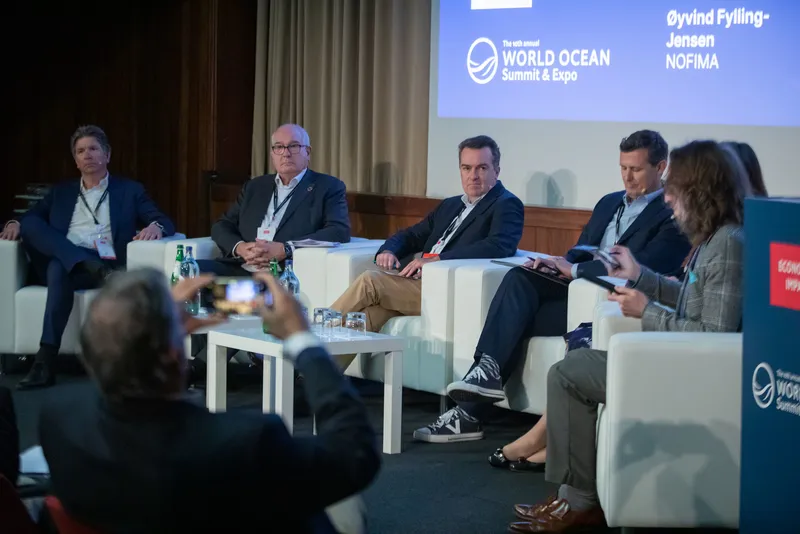
From fish scales to microalgae: Collaboration is key in blue biotech
Panellists at the World Ocean Summit discuss the challenges—and wide-reaching potential—of marine biotechnology

From data sets to data flows: making the case for open-source ocean science
Experts at the 10th annual World Ocean Summit explained how sharing information and creative communication can benefit the entire ocean community

Peak plastic: how we can solve the plastics problem within a generation
Experts at the 10th annual World Ocean Summit highlighted holistic solutions and got detailed about what the forthcoming global plastics treaty could look like

Regenerative coastal tourism: protecting the planet through unforgettable experiences
Speakers at the 10th annual World Ocean Summit highlighted the planet-saving power and profitability of regenerative blue tourism

Net-zero shipping: how maritime transport can rapidly reduce emissions
Speakers at the 10th annual World Ocean Summit said the industry wants to decarbonise, but a lack of regulatory and market drivers is getting in the way
End of carousel.